Of Prophecies and Property Rights

Chronicles of Klept: Chapter X


Day woke us all at first light. There’s something quietly unnerving about Elves. It’s not the pointy ears or the grace, but the way they don’t sleep. Just sit there. Still. Watching. What’s even more unnerving is that I haven’t seen Day make any adjustments to his hair at all and yet it’s still immaculate.

Everyone began to rise – Umberto lay coo-ing and clutching his Dongswallower signed parchment. In this moment, soft and childlike, he was the exact antithesis of the raging destructive force he usually displayed. 

Carrie fluttered above him and muttered ‘he’s so sweet when he sleeps

Trust me, it doesn’t last long,” Din replied. He stoked the embers of last night’s fire and set about cooking a simple breakfast. 

The morning discussion quickly turned to yesterday’s events and the recent discoveries.

Three medallions,” Trunch looked at Wikis who reluctantly removed them from wherever they were being kept in her coat, “and a brick that seems to resurrect the dead” – that was produced wrapped and kept off the ground (just in case).

That’s just what came from the graveyard,” Day added, looking to Yak who, in between mouthfuls of breakfast, produced the small metallic box he had found in the Lenn house. 

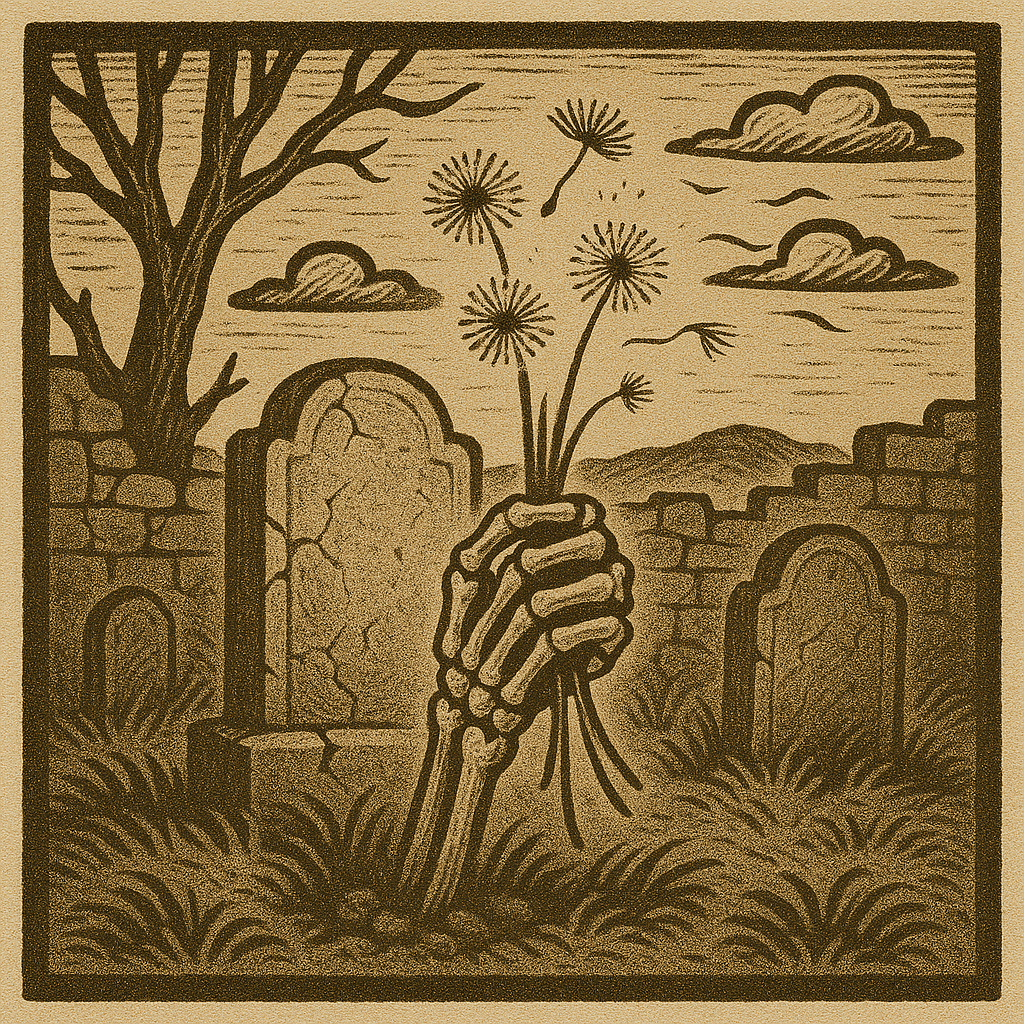
There’s two brooches in here, not medallions but the same symbol. The wilted Dandelion flower in a bed of thorns.” Yak spoke with a mouthful of crumbs.

Don’t forget the list” Carrie cried out “There was some kind of list in the box as well.

Inside the box was also a folded piece of parchment paper. It seemed to be a list of some kind but it was written in a language that none of the group could translate. 

It might be a list of people we should try and find or ‘talk to’” Umberto grunted lifting his axe above his head as if it were a dumbbell and he was doing morning reps. 

It could be an old family recipe for cabbage soup for all we know,” Din added forlornly. No one had spoken about his trance – there seemed to be a general agreement that he would talk about it when he was ready, but something was different about him. He had sat, not moving, not making a sound,  in front of that Sparkwhisker gravestone for over an hour.

We should return to Dawnsheart,” I said, with the tone of a man who very much hoped someone responsible would take over soon. I, Klept, had no intention of loitering about like a spare coin at a beggar’s feast. I wanted to see Tufulla, partly to report our findings, but mostly to be officially and ceremoniously relieved of my continued association with this increasingly unpredictable group. “We should inform him of what we’ve uncovered,” I added, hopefully. “Surely the White Ravens have the appropriate personnel, enchanted implements, and overall constitution to deal with… well, this.

The group didn’t agree, or disagree with me. They nodded – items were packed away and we began the slow walk back to Dawnsheart. 

About 25 minutes into our walk, Day spoke up.
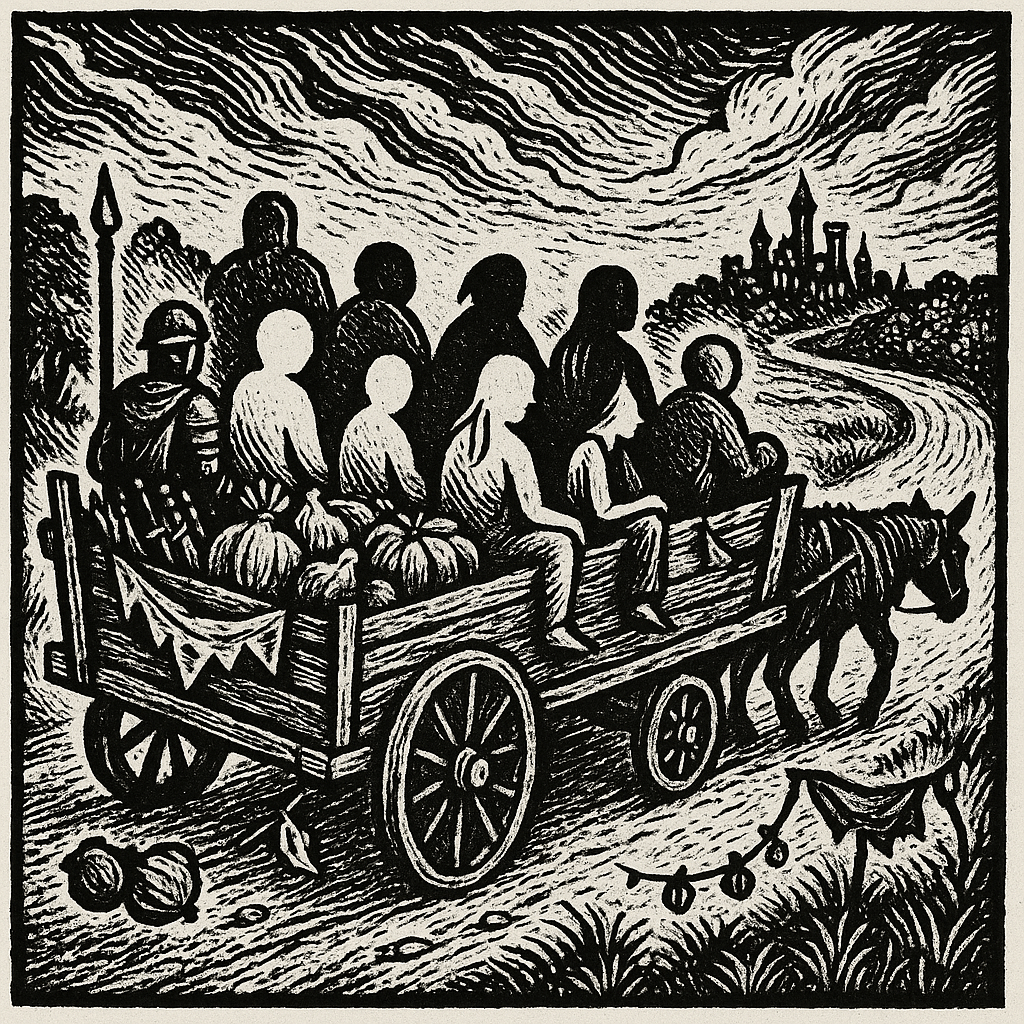
Didn’t we make this trip in a cart yesterday?”

There was a moment of silence. Heads turned.

Wait…” Carrie said, fluttering above the group with a piece of breakfast still in her hand. “We did have a cart. And mules. We just… left them back at the graveyard, didn’t we?

She gave a cheerful shrug. “Well, at least they’ll keep the grass down. Brandt doesn’t seem interested in the job anymore.

Umberto stopped walking. Slowly, deliberately, he turned to look at me.

You were there, Klept. You wrote it down, didn’t you? That’s why you’re here isn’t it?” Umberto barked, thrusting one hand out flat like he was offering a target. Then he stabbed his other finger into his palm with the force of someone nailing down a coffin lid, “to write things down, so they are remembered. You do know how to write, don’t you?

I blinked.

The cart. The almost comfortable, not-walking cart. That should’ve been chronicled.

I was focused more on the rising dead and resurrecting bricks, actually,” I replied.

Well, maybe next time, you could scribble ‘TAKE THE CART’ in big letters somewhere between your divine doodles and graveyard haikus,” Umberto muttered, hoisting his axe onto his shoulder and trudging onward. “Unbelievable. After all the undead nonsense and the lack of answers, we’re walking back to town? On foot?

We did also get a box of possibly cursed accessories and a brick that raises the dead.” Din spoke for the first time in a while. 

Oh good. A brick.” Umberto sighed and trudged on, muttering to himself. “I told the old man bringing a chronicler was just asking for disappointment.

I opened my mouth but Trunch just shook his head at me, pleading with me not to say anything.  

That’s when Yak appeared beside me. I hadn’t seen him approach — which is typical, if mildly disconcerting.

Don’t worry too much,” he said quietly, eyes on the path ahead. “He’s always cranky.

He reached into one of the many folds of his robe and, with a magician’s sleight of hand, produced half a sizzlecake — slightly squashed.

For you,” he said, placing it in my hand like a sacred relic.

I stared at it.

Was this…?

Let’s not ask too many questions,” Yak replied, patting me on the shoulder before walking away.

I took a bite.

It was, against all odds, still surprisingly pleasant.

Umberto didn’t speak to me for the next ten minutes. I considered it a gift.


We arrived back in Dawnsheart through the northwest gate around mid-morning.

The town was alive—carts rattling, vendors shouting, boots on stone—but there was a thin layer of unease beneath the bustle, like tension tucked just under the cobblestones. The energy was there, yes—but the cheer had gone missing.

A pair of guards stood at the gate, and one of them, broad-shouldered, breakfast crumbs still on his collar, stepped forward with a hand raised. His eyes narrowed as he took us in.

Wikis, ever subtle, was scanning rooftops like she expected an ambush. Umberto was visibly clenching his fists and radiating barely-contained fury. Din looked tired. Trunch looked like a man mentally budgeting for incoming chaos.

Yak, who had somehow materialized from nowhere, was the first the guard seemed to recognize. A flicker of memory crossed his face.

Then he saw me.

Klept?” he asked, straightening a little. “Reader Klept?

I nodded, perhaps a little more formally than necessary. “In the flesh. Though slightly more bruised than yesterday.

Recognition settled across the guard’s face like dust returning to a shelf. I remembered him now, he’d been stationed in the square yesterday, during the  golem attack in the cathedral. 

He lowered his hand. “Apologies. You lot just… you don’t exactly blend.

I suppose that’s true,” I said, glancing at my travelling companions. “This lot seem to specialize in public disruption and questionable timing.

That earned a tired, wry smile from the guard. Umberto glared at me. Carrie hmpfed.

Then the guard gave a small nod toward the cathedral.

The High Reader gave the prophecy read last evenin’. Didn’t sit well with many folk. Not that the message was bad, just… heavy. Said sometimes prophecy don’t mean what it seems. It’s not about what it says, but how we face it.

He looked out over the streets, where the morning light painted everything in gold and shadow.

Folk are still talking about it. Quiet, like. But it’s sticking. Moods likely to be down for a while

I guess the taverns will do a bit more business then” Day spoke carefully, as if assessing whether a joke would be appropriate or not. 

I ‘spect they will, which likely means a bit more work for us. Just make sure you lot aren’t caught up in it” he cast a wary gaze over the group, lingering on Umberto and Wikis just long enough to imply he knew their type.

We promise to be on our best behavior” Din raised a hand in what may or mat not have been mock respect.

The guard nodded curtly, stepped aside, and waved us through with one hand.

As soon as she was past, Carrie turned and stuck her tongue out at him, careful to make sure he didn’t notice. 

As we passed through the gates, the town unfurled before us — familiar, but quieter. Dawnsheart always had its share of weariness, but now it wore it openly, like a shawl draped too tightly against a coming storm.

The guard’s words lingered. The message isn’t always what it seems.

I remembered the Read. The light on the glyphs. The pattern that emerged.
The mention of the arrival of outsiders.

At the time, I assumed it meant foreign diplomats. A traveling scholar. Perhaps a metaphor.

I did not assume it referred to a gnome who screams at skeletons, a changeling with a pastry pouch, or a halfling who treats valuable relics like spare buttons.

And yet, here they are. Loud. Chaotic.
And just possibly, the beginning of something.

They fought. They bled. They risked their lives for people they didn’t know, against enemies they didn’t understand.

But they also bickered, interrogated a child, and nearly set a graveyard on fire.

Outsiders, certainly. Whether they’re the right ones… that remains to be seen.

I tightened my grip on my journal. The path was lit, yes — but by torchlight or wildfire, I couldn’t yet tell.

As we rounded the bend toward Dawnsheart’s town square, the road widened and the cobbles began to warm up beneath our feet as the sun beamed down. A gentle breeze stirred the smoke rising from hearth chimneys, curling it into lazy spirals above the rooftops.

That’s when we saw them—half a dozen children darting through the street ahead, shrieking with laughter. One had a stick shaped like a wooden sword, another wore a too-big helmet that slipped over his eyes with every step. They raced past us in a flurry of giggles and scuffed boots.

But one boy slowed as he passed. He was barefoot, wild-haired, and gripping a battered broomstick between his legs. He wasn’t galloping like a knight or cackling like a pretend witch. No, he crouched low, face serious with determination, steering his “steed” through invisible waves.

Across the cobblestones, he shouted, “Hold steady, bean! Don’t you dare sink now!”

And then he kicked off again, paddle-miming wildly, skimming around the corner like it were a sacred lake.

Wikis stopped mid-sentence. Din tilted his head.

Trunch kept walking, oblivious, until Yak appeared beside him and gently placed a hand on his shoulder.

“Trunch,” he said quietly, nodding toward the scene.

Just then, a girl with a crooked braid and scraped knees glanced up and saw us. Her eyes lingered. First on Din, then on Wikis, then finally on Trunch. A look passed over her face: the kind that knows a story when it sees one.

She didn’t say a word.

But Trunch saw it too. He stepped forward, raised a finger to his lips in a gentle shush, and gave her a single, conspiratorial wink.

The girl giggled, turned on her heel, and bolted after her friends, grinning so wide it might’ve wrapped around her head.

Yak and Umberto stood beside Trunch, one hand each on his shoulders.

“This is how it starts,” Umberto murmured, half-whispering. “A bean. A wink. A game. And soon, your actions become the stuff of legend.”

Yak nodded solemnly. “Next thing you know, they’re naming pies after you.”

Trunch said nothing. But he cleared his throat quietly, and for a moment, the ever-so-slightest tilt of his head made him look taller. Like maybe, just maybe, he was standing a little prouder.

We walked on, the story we carried leaving beginning to take root among the cobbled streets. Until, several steps later, Carrie fluttered around to face Trunch.

Her eyes lit up.

“Oh my gosh,” she gasped, jabbing her finger at him like she’d uncovered a scandal. “You were the guy. On the bean. At the festival.”


We made our way toward the cathedral, because that’s what you do when you have unanswered questions and your backpack is full of cursed heirlooms. You go to the man who wears a fancy robe on purpose.

At least, that was the intention.

What I’ve noticed with this group is that they operate less on a collective focus and more on something that resembles the curiosity of a pack of particularly inquisitive raccoons. All it takes is a flash of light, a wafting odor, or a loud noise and they are drawn to it like drunkards to unattended baked goods. 

We made it as far as the town square.

A commotion had gathered near the community notice board, shouting, scuffling, and the unmistakable tone of someone being publicly humiliated.

“It should be mine by right!” a man’s voice rang out.

“Make him fight for it!” another yelled.

“Sign up for the fight, you pompous prick!” a woman cheered.

The group looked at each other.

Sign up for the fight?” Wikis mouth at them quizzically.

That was all it took.

Umberto surged toward the chaos with the enthusiasm of a man who’d just heard the words “public violence” and “legal loophole” in the same sentence. Wikis followed close behind, eyes already scanning the crowd for opportunity, exits, and pocketable valuables. Din trailed them with the reluctant gait of someone who had seen how these things usually ended—and knew they were going to end that way again.

What’s going on?” Umberto barked, elbowing his way through the throng.

A short, red-faced woman with an apron half-off her shoulder turned to him. “People get to sign up for a fight, winner gets—

She didn’t finish.

By the time she’d managed her second breath, Umberto had already grabbed the charcoal stub from a dangling string and scrawled his name across the sign-up sheet pinned to the board. The handwriting was furious, the letters all uppercase and slightly aggressive, like the parchment had offended him and he was teaching it a lesson.

The rest of the group, swept along in the Umberto-shaped wake, began inspecting the notice as well. Several names already adorned the list, some in elegant, calligraphic flourishes, others with the jagged scrawl of someone trying to spell while mid-punch. None of them, however, had quite the sheer volume of personality as the newly added UMBERTO.

The fight, it seemed, would be held the next morning. Sign-ups closed that afternoon.

A fight’s a fight,” Umberto said with a shrug. “And this one’s legal. That’s practically recreational.

One by one, the others began adding their names to the list.

I suppose maybe we should find out what we’re fighting for?” Trunch offered dryly, his quill hovering just above the parchment.

I don’t need a reason,” Umberto said, rolling his shoulders. “Just a fight. Bit of physical therapy, if you know what I mean.

Din leaned in, squinting at the fine print. “Weaponry permitted if both combatants agree… magic allowed but single-target only—‘no fireballs or area of effect’… reasonable.

Carrie fluttered in front of the board, tracing the list of names with a finger. “Wait, if the matches are random, does that mean we might end up fighting each other?

Oh,” she said brightly, looking at Trunch. “Can I fight you?

I’d rather not,” Trunch replied, calm but already bracing for a future where that was somehow inevitable.

Wikis was still staring at the sign-up sheet like it was hiding something. “Do we know if the prize is cursed?” she asked. “It feels cursed. I just think someone should ask.

Yak, from behind her, silently signed his name upside-down and backwards with a flourish. “If it’s cursed, all the better,” he said.

Trunch finally signed with a sigh, then turned to look at each of us in turn. Not dramatically, not accusingly—just… sizing us up.

His gaze was slow. Measuring. Like a man mentally sorting tools into those that would last in a storm, and those that might snap.

And just beside him, Day stood motionless, arms folded, watching the group with that same unreadable calm he always wore—only this time, his eyes weren’t distant. They were studying.

He didn’t speak. He didn’t need to.

You could feel it. He was running calculations behind those eyes. Not just strategy—but probabilities. Weaknesses. Openings.

That’s when it hit me.

A sudden, quiet understanding clicked into place, like a blade slipping into its sheath. Clean. Unsettling.

At the core of it, this group—this party, this gloriously disjointed collection of chaos—was still made up of strangers. They had fought side by side, yes. Shared meals, near-deaths, occasional goats. But under all that, there were still vast unknowns between them.

Fighting alongside someone is one thing. Knowing what they’ll do when you’re in their way… that’s something else entirely.

Trunch was already thinking about it.

Day already knew.

Because this tournament wasn’t about strangers anymore.

It was about what happens when allies become opponents.

And there was a very real possibility that someone in this group might actually win.

I swallowed.

Now, more than ever, I wanted to ensure that my connection to them—this assignment as chronicler—would end. And soon. Before I got pulled even deeper into something I was already beginning to regret more thoroughly than most of my theological education.

That’s when the crowd parted—literally.

A massive orc muscled his way through the square with the slow, unstoppable confidence of a glacier wearing boots. He didn’t shout. He didn’t growl. He didn’t need to.

People moved.

He stepped up to the sign-up sheet like it owed him money.

Someone had just finished signing up. They turned, looked up and stood frozen with the stub still in hand. The orc loomed silently at his side, a living monument to muscle and menace. The poor fellow looked up, wide-eyed, then slowly—trembling—extended the charcoal like an offering. The orc didn’t look at anyone. Didn’t ask if it was his turn. Just grabbed the charcoal and started writing—if you could call it that.

Two letters. Big ones.

AZ

They swallowed three names whole and took a solid bite out of a fourth. The strokes were thick, messy, and somehow aggressively earnest. The kind of letters you’d expect from a toddler discovering uppercase for the first time—and winning. The letters were thick and clumsy, but the way he formed them? That took effort. Focus. Pride.

And it wasn’t just the writing. I clocked the way he held that charcoal. Like it meant something. Like it was more than a tool.

Then, just as silently, he turned and walked away. No words. No threat. Just the echo of his footsteps and the lingering scent of muscle oil and oh no.

The pompous man from earlier—the one shouting about inheritance rights and tradition—simply nodded as the orc passed. The nod of a man who had just outsourced his fistfight.

The silence that followed was thick enough to chew. One or two names on the list were quickly and quietly crossed off by their respective owners—no fuss, no comment, just a sudden and profound change of heart.

Carrie cleared her throat and turned to Wikis.

Okay,” she said. “We really need to find out what we’re fighting for. Especially if it means fighting him. Or…” she glanced sideways at Day and Trunch, who were still eyeing each other with quiet calculation, “each other.

Wikis slowly nodded, still staring after the orc.

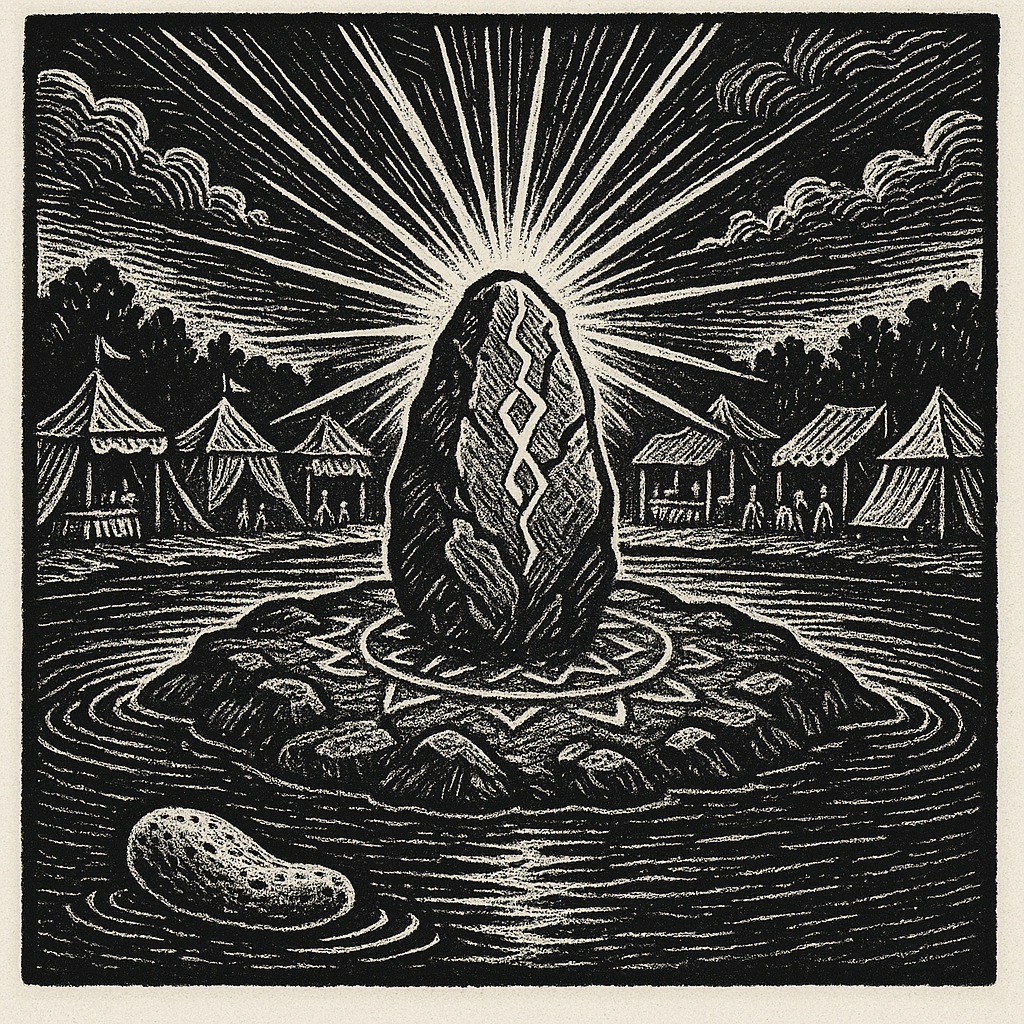
It’s a property dispute,” one woman explained leaning in, arms crossed, eyes fixed on the growing list of contenders. “Fights are drawn at random from those who sign up. Winner moves on to the next round. Last fighter standing at the end of the day wins the deed.

The fancy-looking fellow over there”, she gestured with her chin toward a well-dressed gentleman who was gesturing animatedly to what looked like a city official, “he thinks it ought to be his. Says his father owned it.

But!” piped up an older man in an enormous hat, stepping in like he was sharing state secrets, “his father’s will says the property has to be won. That’s how he got it, years back. Won it in a card game.”

Trunch and Day had stopped sizing the group up and had begun to listen. Umberto stood, arms crossed watching the orc lumber across the square.

I heard it was a chicken race,” someone added.

Pie-eating contest,” another insisted. “Four rounds. Crust was the tiebreaker.”

Oh, what kind of pie?” Yak was suddenly more interested in the conversation than the crowd’s coat pockets.

Don’t matter what kind. Neither pie nor competition,” said the woman again. “It’s the tradition that matters. Has to be won—fair and public. Apparently, Thornstar, the previous owner,  loved a good fistfight. Said it revealed true character. Traditions are important ‘round these parts.” She gave the group a steely once-over as if to say ‘I know you lot ain’t from ‘round ‘ere’. She lingered on Trunch just long enough to mean his face was filed in a box somewhere in her mind, but not long enough for her to pull out a pile of boxes and sort through them. Somehow she seemed to come to the conclusion they weren’t problematic.

Carrie leaned in, eyes gleaming like she’d just heard the prelude to a juicy scandal. “So… what kind of property are we talking about?

Is it a warehouse?” Trunch asked, straight-faced. “That would be a good place for unsanctioned fistfights.

The old man’s house?” Wikis asked suspiciously, already scowling like it might be haunted and full of breakable valuables.

No, no—nothing like that,” the old gentleman said, practically twinkling now. “It’s a wee tavern.

There was a beat.

Then Umberto and Din turned to each other, eyes wide.

It was the kind of look usually reserved for children who’d discovered the candy stall at the festival had no supervision and an honesty box system.

Did he say tavern?” Umberto whispered, breathless.

Din nodded, solemn as a priest. “He did.

And then it happened.

They grinned. Wide, unfiltered, dangerously joyous grins. The kind of grins that suggested two men already fantasizing about custom tankards, a beef jerky wall, and permanent discounts for anyone who could out head-butt a ram.

Oh,” Umberto said, cracking his knuckles, “I’m winning this.

I’m gonna sleep under the bar,” Yak added. “On purpose.

That’s when a nearby bystander leaned in—a sharp-eyed woman with a fraying bonnet and a voice like cracked gravel.

To be fair,” she muttered, “The Goblin’s Grin’s a run-down shit hole. Roof leaks. Floor sinks. Pretty sure the back room is full of mushrooms that bite.

The Goblin’s Grin” Din let the words linger on his tongue like a particularly sweet candy.

Half the folks signed up just to knock the place down,” added a lanky man with one eyebrow and a sack of turnips. “It’s a dark, poky little hole. Smells like damp socks and something best left unfound.

Umberto turned slowly to face him.

It sounds perfect,” he said, eyes gleaming.

Carrie gave a satisfied exhale. “Sounds like it’s got character.

Is it stocked?” Day had a sparkle in his eyes I hadn’t seen before.

At that point that I, the one with the functioning long-term memory, made the executive decision to leave the group discussing property details and battle plans and make my way to Tufulla, to debrief him  on our Nelb discoveries as was the original plan this morning. 

I slipped away toward the cathedral, journal under one arm and the beginnings of a stress headache forming behind my left eye. The mayor’s office, I noticed, was shuttered with a hand-scrawled sign in the window: TEMPORARILY CLOSED. ARREST PENDING. A rather elegant euphemism for Roddrick finally got caught doing something too obvious to weasel out of.

As the bells of the cathedral chimed the quarter-hour, I adjusted my robes, steadied my breath, and prepared to find High Reader Tufulla. I had information to deliver, a prophecy to report on, and, if the gods were truly kind, an opportunity to be officially and ceremoniously released from my ongoing involvement with the chaotic group causing a ruckus around the town board.

The doors to the cathedral were open, technically so was the window next to them. The glass shards had been swept up and there was some scaffolding erected but it was just still an empty space where a beautiful stained glass window had once been. A few townsfolk sat scattered across the pews, heads bowed, not praying so much as lingering near holiness in the hope it would rub off.

Tufulla was near the pulpit, speaking in low tones with an individual I didn’t recognize. When he saw me, the High Reader raised one hand. Not in blessing. In pause.

He finished his conversation, nodded gravely, and dismissed the mystery individual. Then he turned toward me, his expression tired, but, much to my surprise, relieved.

You returned,” he said. “And the rest of our interesting little group are?” he looked past me as if to expect them to come crashing through the door on the back of an angry dragon.

Signing up for some kind of street brawl” I replied “Is that sort of thing actually legal?

Probably,” Tufulla replied, unfazed. “Who knows what kind of things Roddrick signed into law? The man had no clue what he was doing. But, I assume there’s a pile of paperwork involved and things to sign, and, if they are consenting individuals then…” he waved his hand as if to clear this thought from his space “what did you find? In Nelb. I see you came back in one piece.

I gave a slight shrug. “We found… things. Enough to suggest your theory about the Dan’del’ion Court isn’t incorrect.

Tufulla’s gaze sharpened, but he simply nodded. “Come. Walk with me.

He turned, and I followed him down the central aisle. The cathedral’s stained-glass windows threw fractured light across the stone floor—sunbeams filtered through saints, symbols, and stories long forgotten by most.

Outside, the world carried on. Inside, it felt like time held its breath.

You’re certain?” Tufulla asked softly.

As certain as one can be when traveling with a group like this,” I replied. “The dead were rising in the Graveyard.

That was mentioned in the report from Brandt. Was he much help?

They knocked him out. Well, Umberto did. He was drunk.”

Tufulla looked confused.

Brandt. Brandt was drunk. He seemed to have given up. Wasn’t helpful. The group decided to get information in their own … special way.”

We left the calm of the cathedral behind, just in time to hear shouting from across the square.

Din was using all his strength to hold Umberto back. 

Umberto was yelling at a young gentleman with the fury of a held back hurricane. “Barbara Dongswallower is the greatest literary artist in history

Oh, please – it’s obvious she uses a ghost-writer. Her prose is awful.

Day and Trunch had joined Din in holding Umberto back and yet Umberto was still slowly moving toward the young man. Wikis had drawn her bow and was using it to keep the crowd at bay. Carrie pressed a finger into the man’s chest.

If you’re really that smart,” she said with a bite “you’d recognize now as a good time to walk away.

Yak sat cross legged on a nearby table, watching it all unfold with pastry in hand. I thought I could see a smile in the dark recesses of his hood even from across the square.

The group, it seemed, were thriving.

Tufulla exhaled slowly.

You know,” he said, “I’m impressed you made it back completely unscathed.”

I straightened my robes with mock pride. “Oh, I wouldn’t say completely unscathed. But most of the damage is emotional.

Tufulla paused, hand resting lightly on my shoulder.

I see. It sounds like we have some things to discuss. How about a pint?

Oh, Gods. Please.

The Subtle Art of Extracting Information

Chronicles of Klept: Chapter IX


Brandt’s door rattled when Trunch knocked. Then again when Umberto pounded on it with his fist.

From inside: silence.

Then, eventually, the shuffling of reluctant feet. A click. A creak.

The door cracked open, and Brandt Ulfornd peered out like a man deeply disappointed that he was still alive. He smelled like the unmistakable scent of disappointment soaked in alcohol. His robe was inside out. His eyes were bloodshot. His general aura was that of a man who’d found rock bottom, bought property there, and was currently renting out the basement.

“...You again,” he mumbled, blinking slowly. “Didn’t I already give you a key or… a goat… or something?

The key. Yes,” Trunch said gently. “About twenty minutes ago.

Right. Good key. Worked fine?

Perfectly,” Umberto said, stepping forward. “Now we have follow-up questions. About the Lenn family

Brandt blinked again, swaying slightly. 

The Lenns?” he repeated, squinting at us like we were a particularly unwelcome hangover. “They were… fine. Good folk. Kept to themselves. Generous. Rich, of course.

He leaned against the doorframe, bottle still in hand, and waved vaguely toward the hill.

Built that big house up there. Put up the mausoleum down here. Paid for the flower beds before the weeds won. Didn’t cause trouble. Didn’t attract trouble.” 

He took another swig, winced like the drink had punched him back. “Look, if this is about the dead in the graveyard—they’re handled now, right? You sorted that. Lovely work, truly. Very brave. You have my thanks”. He gestured weakly toward the cemetery behind us, as if sealing it shut with a flick of his fingers. “So if it’s all the same to you…kindly bugger off and leave me be

He started to close the door, but Umberto stuck a foot in the frame.

Look, old man,” he said, trying very hard to be patient and failing miserably, “we’ve got skeletons literally clawing their way out of the ground and your name on the caretaker’s ledger. So unless you want to join them—

You don’t scare me,” Brandt snapped. “You think you’re the first thug come knockin’? I kept this place in order long before any of you were—hic—playing dress-up with swords!

He shoved the door. Umberto shoved back.

There was a brief scuffle, which ended with Brandt sprawled unconscious on the porch, snoring like someone trying to breathe through gravel.

Problem solved,” Umberto said, dusting his hands. “Let’s search the house.

You can’t just knock people unconscious because they’re uncooperative!” I protested.

He started it! Would you have preferred I set him on fire?

I would have preferred a conversation!

That was a conversation,” he said.

Wikis, naturally, had already let themselves in.

The house was a disaster. Papers everywhere, dishes stacked in odd places, furniture that hadn’t been moved in years. But amidst the chaos, a strange kind of order: shelves stacked with carefully labeled books, maps, records, family trees—drawn and redrawn in painstaking detail.

The fairy flitted across the ceiling beams, peeking into boxes and scroll tubes, occasionally dusting things with the hem of their coat.

Messy house,” she said, “but mostly meticulous records. Something changed recently though.”

Something broke,” Wikis said, flipping through a massive leather-bound volume. “This man catalogued births, deaths, and dental appointments going back decades. And then… nothing. About eighteen months ago. Everything stops.”

They laid the book flat.

L-E-N-N,” Wikis read. “Markus and Lilly. Arrived from out of town years ago. No listed origin. Very wealthy. Buried in the mausoleum.

And their daughter?” I asked, already peeking out the dusty window.

Still alive. Brenne Lenn,” the fairy said. 

Lives alone in the family homestead” She and I spoke at the said time. Her reading from the ledger, me pulling from memory.

There was a pause.

How do you know that?” Day asked suddenly, his voice cool but not unkind.

I turned, surprised—and was immediately reminded that Yak exists in a constant state of surprise appearances.

He emerged from behind a stack of crates like a theatrical specter and pressed a dagger gently—yet meaningfully—against my throat.

What else do you know that you’re not telling us, Chronicler?

I’m a Church historian,” I said, carefully. “Tufulla didn’t bring me along for my swordplay. He sent me because I know the valley.

Yak’s eyes narrowed. The dagger didn’t waver.

The Lenns were prominent,” I continued. “Not just in Nelb. In Dawnsheart too. Wealthy, generous. Contributed to civic works, charity funds, temple restorations. Always smelled faintly of lavender. Their family name is carved on a bench in the cathedral’s west wing, next to the donation box that leaks.

The dagger lowered.

You could’ve told us this earlier,” Umberto said, leaning against the doorframe with arms crossed and an eyebrow raised. “Y’know—before we got here. Before the graveyard. Before Brandt went night-night.”

I blinked at him.

You didn’t ask. You all just… ran off with weapons drawn and a vague plan involving improvised violence.

That does sound like us,” Day mused.

Carrie floated past with a ledger under one arm. “So… where’s this mysterious house, then?

I pointed out the window. Through the mist, the Lenn estate sat atop a modest hill—looming just enough to be foreboding, picturesque enough to be tragic.

There,” I said. “Two stories, slightly crooked roof, probably haunted. You can’t miss it.

Trunch leaned under my shoulder and nodded.

Think we should talk to her?

Yes,” I said. “But maybe not with the same tact you used on Brandt.”

I nodded toward the porch, where our gravekeeper lay in a heap—snoring, twitching, and absolutely unhelpful.

Let’s try knocking with words this time.

We left Brandt snoring on the porch, surrounded by broken bottles, scattered papers, and the lingering aroma of disappointment.

Let him sleep it off,” Umberto said, waving a hand like he’d just performed a mercy. “He’ll be fine. Or not. Either way, quieter.

I didn’t argue. At this point, I was saving my energy for more important things. Like regret.

The hill that led to the Lenn house was soft underfoot—overgrown grass, patches of wild onion, the occasional cabbage stalk creeping too close to the path. The house loomed above us like it had grown out of the hill rather than been built into it. Two stories, weathered shutters, and an uneasy stillness that made the air feel thicker the closer we got.

I took the lead. Not because I wanted to, but because if I left it to the others, we’d arrive by battering ram.

Behind me, Umberto was stomping up the path like the very concept of hills had personally insulted him.

He was… louder than usual. Angrier, if that was even possible. His jaw was tight, his eyes sharper than they needed to be, and he kept muttering about “rich people’s secrets” and “shady hilltop bastards” under his breath. If Din had been here, he might’ve offered a calming word. A logical argument. A steady hand.

Instead,the hand on Umberto’s shoulder belonged to Carrie.

Imagine, if you will, a fairy bard at the height of her powers—if those powers included an unshakable need for attention, the color palette of a gemstone heist, and an instrument that sounds like it’s been possessed by a musically gifted banshee with stage presence.

Carrie is barely three feet tall, though she somehow radiates tall. Her wings shimmer like stained glass windows mid-mutiny—flashes of violet, teal, and emerald that could either dazzle a crowd or distract a charging owlbear, depending on the lighting. Her hair is a riotous shade of sunset orange, styled in a way that suggests either careful intention or magical accidents she pretends were on purpose. She pins the more rebellious strands back with glittering clips shaped like musical notes. Of course she does.

Her clothing is what happens when someone says “travel light” and she hears “travel fabulously.” A velvety purple bodice embroidered in golden swirls wraps around her like a melody about to burst into song. From the waist down, she’s draped in a cascade of jewel-toned silks—sapphire, ruby, emerald, amethyst—like a patchwork tapestry that sings when she walks. The sleeves don’t match, obviously. One is snug with braidwork, the other is pure drama.

Strapped across her chest, like a knight’s sword or a mage’s staff, is a set of bagpipes. And not just any bagpipes—no, these are polished mahogany, inlaid with silver vines, the bag itself a forest-green leather etched with arcane musical symbols that pulse faintly when she plays. It’s all very subtle. If you’re blind.

She also carries a satchel full of sheet music, shiny things she’s ‘collected’ (read: definitely not stolen), and an alarming number of polished stones that she insists are ‘emotionally resonant.’

Her boots, laced with crimson ribbon, are technically for travel, though one suspects she judges every village by the acoustics of its town square. A small pendant shaped like a swirling gust of wind hangs around her neck—enchanted, of course—to ensure her solos arrive with appropriate drama.

And when she plays? It’s impossible to ignore. The sound is somewhere between a battle cry and a love letter, fierce and haunting, like someone casting Bardic Inspiration through a parade.

She’s dazzling. She’s maddening. She will absolutely make you a theme song before asking your name and she seemed to almost enjoy egging Umberto on.

We should demand answers! You won’t get the right results if you’re charming about it.” She was hovering just next to him, wings beating furiously to keep up. I’m sure she would have used less energy if she just walked alongside him.

I’m not here to be charming,” Umberto growled.

Exactly!” Carrie beamed. “That’s your charm.”

Wonderful, I thought. I’m leading a powder keg. And someone’s giggling while holding the match.

As the house grew closer, I stepped a little faster, trying to subtly put myself between Umberto and the front door before he kicked it open and demanded someone’s inheritance.

Listen,” I said, holding out a hand as the porch came into view. “I think I should do the knocking. I don’t know Brenne all that well, but we have met before, and I can use the Church as a legitimate reason for our visit.

Trunch nodded, a hint of shared concern in his expression.

That sounds wise. Maybe… introduce us, ask a few church-related questions, and we’ll try to steer it naturally toward the important stuff as we go.”

Church business is important,” I reminded him “To some people.”

I stepped up onto the creaking porch—slightly warped boards, paint peeling in gentle surrender—and raised a hand to knock.

Three firm taps.

The sound of footsteps approached. Then the door opened.

Brenne Lenn stood in the doorway.

She took one look at me—specifically, at my robes—and her expression softened.

Good Afternoon, Reader,” she said, with a small, reserved smile.

You may not remember me,” I began, giving my most diplomatic bow, “but I’m Reader Klept from the Church of the Prophet, in Dawnsheart.

She looked at me, and for a moment—just a flicker—there was something in her gaze. Recognition, certainly. Possibly… something else?

I missed it entirely. Carrie did not. Hovering just behind me, she leaned toward Wikis and whispered—not quietly—

Oh, honey. She apparently remembers, alright

Wikis didn’t respond, but I heard a quiet snort.

I do apologize for the intrusion,” I began, adopting the careful tone of someone trying to ease open a wary conversation. “We wouldn’t normally arrive unannounced, but given the circumstances—”

Which is, of course, when Umberto blew past me like a storm through a library.

This is taking too long,” he barked, brushing against my shoulder and storming through the door as if he owned the place. “I’ve got questions, and I want answers. Preferably before the next corpse gets back up and asks me something.

Brenne took a startled step back. “Wait—what is—?

Umberto,” Trunch called out, sighing mid-apology as he followed after him. “He means well. I think. Sometimes. Sorry.”

Her eyes darted from the increasingly crowded entryway to me. I offered my most disarming smile. “As I was saying… Church business.

She didn’t look convinced. Which was fair, considering one of our group had just let himself in like an angry relative come to dispute a will.

From behind me, Carrie’s voice piped up brightly.

Oh, I like this energy,” she said.

Trunch attempted to smooth things over the way only someone flanked by an armed lunatic and a church scribe could.

Brenne,” he said gently, “you’re safe. We’re not here to hurt you, and this really won’t take long.

It better not,” Umberto added, already pacing across her sitting room like he was preparing to interrogate a ghost.

I hadn’t even made it fully into the house before Trunch turned to me.

Klept, be a dear and make some tea, would you?”

Which, of course, is exactly what you ask the chronicler to do during an investigation. Tea. Vital stuff. History can wait.

I retreated to the kitchen in search of something approximating a kettle. Behind me, Umberto’s boots thudded across the floorboards as he muttered about ‘secrets in the wallpaper’ and ‘something off about the upholstery.’

Wikis loitered in the doorway like a highly strung cat—eyes darting, fingers twitching, absolutely radiating “don’t trust anything that breathes or doesn’t.”

Day, ever the minimalist, simply said:

I’ll wait outside.”

Then sat on the porch like he was awaiting the world’s slowest apocalypse. The afternoon sun caught the edge of his braid—an infuriatingly perfect thing, all smooth angles and quiet menace—and lit it up like a ribbon spun from bronze.

I would have hated him, if he wasn’t so consistently right about everything.

Also—and I cannot stress this enough—we just fought skeletons. In a graveyard. Right after surviving a golem attack. This morning. By the gods, that was only this morning. And somehow, his hair still looks like he conditioned it with elven moonlight and braided it using the whispers of forest spirits. I tried to remember if he had been brushing it on the cart ride over here but couldn’t. Which somehow made it worse.

Yak leaned on the doorframe, looking so casual I knew he was about to do something reckless. And Carrie—of course—had taken to fluttering about the garden like she was choosing centerpieces for an impending duel.

In the parlour, Trunch began the questioning with the steady tone of someone trying to be respectful.

Brenne, we’re not here to accuse. We’re simply trying to understand if your parents ever mentioned any association with the Dan’del’ion Court—any names, visits, oddities. Anything that might help us piece this together.

Umberto did not share this approach.

Let’s stop pretending,” he said, voice low and sharp. “Your parents were in it. Maybe you are too. If you want this to go well, start telling the truth.

I winced into the teacups.

Halfway through the questioning, I caught movement—Carrie, descending gracefully from above, as though she hadn’t just been spying through an upper window. She whispered to Yak, who turned and whispered to Day, who didn’t react at all… aside from the faintest nod.

Yak slipped silently inside like a shadow that had been invited in by accident.

Wikis, catching the cue, turned to Brenne with a sweetness I did not trust.

Is there a restroom I could use?” she asked, blinking innocently.

Brenne hesitated, clearly frazzled.

It’s… upstairs.”

Thank you,” Wikis said, already moving.

There was no stopping it now. The stealth team had deployed. The interrogation was underway. The tea was steeping.

And I was standing in a stranger’s kitchen with the growing suspicion that this was all going to end with shouting, broken furniture, and an official complaint to the Church.

A couple of minutes later I watched as Yak slipped back outside like nothing had happened, and Wikis re-entered the parlour just in time for the conversation to explode.

Because of course it did.

Trunch was doing his best.

Which is to say, he was carefully and calmly attempting to explain to a grieving young woman that her parents’ final resting place had recently failed to live up to its promise.

We discovered their sarcophagi open,” he said gently. “There are… signs of necromantic interference. We believe someone may be trying to—well—stir the past.

Brenne, understandably, was already pale and trembling.

Then Umberto decided to help.

Yeah,” he cut in, “your parents got back up. All skeleton, no soul. Attacked us. I put them down.

There was a silence. The kind that has weight to it.

Trunch looked like he’d swallowed a tack.

Just to clarify,” he said quickly, “we did not kill them the first time. They were already… post-mortem. What Umberto means is, they reanimated, and we were forced to—

Smash them,” Umberto added with a joyful malice “Again.”

Brenne’s eyes welled, then flared with a different kind of fire.

Get. Out.”

That’s fair,” I muttered.

She stood, trembling, but somehow steady, and pointed at the door with the certainty of someone who’d just had their last shred of comfort torched.

All of you. Now.

And for once, no one argued.

We left as a group—not quite silent, but certainly not speaking. Day rose from the porch without a word, his steps quiet, eyes unreadable. Carrie drifted overhead like a butterfly trying not to laugh, humming a tune that sounded uncomfortably like a funeral march in a major key.

I trudged near the back, notebook in hand, appetite hollow and bitter.

Yak reappeared beside me, chewing on something warm and fragrant. Something unmistakable.

“Well,” Yak added between bites, “that could have gone worse.”

“Yes,” I muttered. “But only if we’d arrived carrying torches and a mariachi band. Where did you even … Is that…?” I asked.

He nodded, mouth full. “Sizzlecake. Still warm.”

I stared at it like a man watching a ship sail away with everything he ever loved.”

He pointed off to the side.

Trunch stood beside a roadside stall, handing a few coins to an old woman who was packing things up. He had one more sizzlecake in his hand, the other already gone. A bag of onions dangled from his elbow like some cruel joke. He didn’t look back.

I felt something wither inside me.

“Move it, Chronicler,” Umberto barked from up ahead. “We don’t have time to dawdle.”

Carrie twirled lazily in the air, her humming now drifting into the second verse—bright, chipper, and completely inappropriate.

I hadn’t had a single bite. Not one. 

We made our way back down the hill—toward the graveyard, and whatever regrettable plan would emerge next.

Din was nowhere in sight.

We called his name a few times, scattered and uncertain, until Carrie’s voice floated out from a corner of the cemetery.

He’s over here!” she called, half-curious, half-concerned.

He was sitting cross-legged in the grass, completely still, positioned in front of a headstone that looked like it had been on the losing side of a decades-long argument with the surrounding flora.

We slowed. Approached cautiously.

Din?” Trunch called out, wiping the last remnants of the last sizzlecake on his shirt.

No response.

Umberto clomped closer and waved a hand in front of his face.

Still nothing.

Should we… poke him?” Yak asked, already halfway committed to the idea.

Maybe, don’t,” Trunch said. “Not yet, anyway

I looked down and noticed the grass, weeds, and moss had been cleared—carefully—from around the base of the headstone. Din had done it, that much was clear. Not in a trance, then. Not entirely. Something deliberate had led him here.

The stone beneath was worn, but not unreadable. Moss clung to the corners of carved lettering, but just enough had been exposed for the name to flicker into view.

D.A.V.O.S.

Beneath it, a carved face—undeniably Dwarven. The beard was rendered in curling, masterful strokes, rising up off the stone like it was caught mid-flow, or charged with static. It shimmered faintly, even without sunlight.

I stepped back.

Sparkwhiskers?” I breathed.

The group went quiet.

Carrie landed lightly beside me and studied the headstone. 

What’s it mean?” She asked.

I think it’s best he tells you, when he’s ready”.

What’s wrong with him?” Wikis asked, circling slowly, eyes narrowed. “He’s not dead, right?

No,” I said. “But he’s… elsewhere.

Trunch knelt beside Din and placed a hand lightly on his shoulder.

Din?” he said again, softly.

Din didn’t blink. Didn’t move.

He was looking at the grave like it had spoken. And maybe, in a way, it had.

Well, this is fucking great” Umberto spat “little miss skeleton parents up there didn’t give us anything” he gestured towards Brenne’s house “and now Din’s catatonic.

“And I didn’t get any sizzlecake” I mumbled. 

“What did you say?” Barked Umberto.

I said, I’m sure we’ll figure out a way to snap him out of it” I offered, in a way that I hoped sounded reassuring. 

And I wouldn’t say she gave us nothing,” Yak said. He exchanged a glance with Wikis and she pulled something out from somewhere under her coat.

Trunch’s brow furrowed. “You stole something, from her house?”.

Yak just shrugged his shoulders.

They found it in the bedroom upstairs” Carrie squealed “I saw them through the window

Wikis placed a small box very carefully on the ground and immediately snatched it up again. 

I don’t think this one will raise the dead” Day offered. 

She scowled at him and placed it down again. Black stone—though not quite stone—with delicate silver filigree edging. And on the lid, unmistakably, the symbol: a wilted dandelion head, nestled in a bed of thorns.

It was hidden under a floorboard,” Yak said, casually cleaning his nails with a dagger like he was recounting a walk through a flower garden. “Room smelled like lavender.

He glanced at me and nodded.

Told you,” I muttered.

And secrets,” Wikis added, sniffing the air like she could catch one mid-sentence. “Definitely smelled like secrets. He accidentally set the trap off” Wikis added nodding towards Yak “but then caught the dart without even looking. It was so cool

Didn’t even blink” Yak added

Oh, you definitely blinked” Carrie huffed.

So she was lying” Umberto was still waving in Din’s face “I knew it”.

I don’t think she knew it was there” Yak offered. “The floorboard hadn’t been touched in decades.”

It’s definitely Dan’del’ion.” Day was holding a medallion next to the box, comparing symbols. “Think we should open it?”

Not here, not now” Trunch added. 

The sound was subtle at first—a sharp breath drawn through clenched teeth.

Every weapon in the vicinity was suddenly out.

Swords unsheathed. A dagger appeared in Yak’s hand. Trunch’s fingers twitched with a spell half-formed. Umberto was halfway into a combat roll he didn’t need to commit to.

Even Day, who had spent most of the afternoon embodying “apathetic statue,” stood with one hand on his blade, expression unchanged but definitely more murder-ready than usual.

Another one?” Wikis hissed, already stepping back and scanning the ground.

But it wasn’t a skeleton.

It was Din.

Blinking slowly, like someone just coming out of a deep, unwanted nap. He looked around at the very armed, very tense circle of friends now surrounding him, and let out a long, groggy exhale. He looked down at the headstone in front of him, the one he’d uncovered by hand, though I don’t think he remembered doing it. The carved Dwarven face looked back at him with a knowing kind of stillness, the spark-threaded beard catching the light.

I don’t know how long we stood there. Nobody said much. Even Umberto didn’t shout, which was unsettling in the way a silent forge is unsettling—you know the heat’s still in there somewhere, waiting to erupt.

Din didn’t move. Didn’t blink. Didn’t acknowledge us at all.

And here’s the thing: I’ve seen people grieve. I’ve seen people break. This wasn’t either.

This was something older. Deeper.

I’m going to need time to unpack that, …what did I miss?” he rasped.

No one answered at first. They were all too busy trying to look like they hadn’t just prepared to decapitate him.

I closed my notebook and sighed.

Should I start with the groundskeeper, or the poor woman up the hill,” I began, before Umberto clapped a hand on his shoulder with all the grace of a falling anvil.

You didn’t miss anything important,” he said. “We still don’t have answers.

And with that, he turned and began stomping back down the path toward the hamlet.

Where are you going?” Trunch called after him.

To get some,” Umberto barked. “One way or another. Someone in this shithole has to know something

Carrie hovered a little higher, clearly thrilled.

Ooooh, he’s doing the dramatic striding thing again,” she whispered to no one and everyone.

Wikis rolled her eyes and glanced at Din.

“He means well,” he said “In his own special way

I tucked my notes back into my coat.

Debatable,” I muttered. “But at least he’s consistent.”

And so, like some half-coordinated theatre troupe at the end of a very strange matinee, we gathered our things and followed Umberto up the dusty path. 

As we moved uphill through the village, doors clicked shut. Curtains twitched. Someone, somewhere, dropped a stack of cabbages in alarm.

Friendly place,” Umberto growled.

His frustration simmered with every step, like a kettle left too long on the fire.

Wikis, ever the pragmatist (and possibly a little desperate for attention), climbed onto a dry patch of fence post and called out into the square:

Five gold for anyone willing to answer a few questions!

It was a good offer. Generous, even.

It was met with silence.

Except, eventually, for a small voice.

A girl—no more than eight years old—emerged from behind a leaning rain barrel, barefoot, bright-eyed, and utterly fearless.

I’ll talk,” she said, sticking out her hand.

Gold changed hands. Questions were asked.

The results were… disappointing.

The girl knew nothing about the skeletons. Nothing about the Dan’del’ion Court. She giggled when Wikis used the word “necromancy” and asked if it was like hide-and-seek but with dirt.

The group’s patience, already thin, wore to tatters.

Their questions sharpened, voices rose, and then—because of course it was Umberto—there was a moment where the air shifted. A tension. A sharp glint in his eye that suggested, if she didn’t start providing better answers soon, he was genuinely considering extracting them by less-than-legal means.

Trunch, ever the diplomat, shifted tactics.

He crouched down, softened his voice, and asked heavier, more difficult questions—about the graveyard, about anything strange the girl might have seen or heard.

But somewhere along the way, something was lost.

She seemed to think this was still a game. That all we wanted were simple, cheerful facts—her name (Petra), her parents’ occupation (cabbage farmers, of course), the number of cats she had at home (three, but two were “mostly wild”).

She answered with the bright sincerity of a child proudly reciting her alphabet, completely missing the tension creeping into every corner of the conversation.

Each earnest answer was another pebble in the growing mountain of frustration.

Wikis, ever the opportunist, crouched down and showed the child the Dan’del’ion medallion.

My mum’s got one a bit like that,” she said brightly.

And then, as if she had just solved a riddle no one else could see, she skipped away down the road.

Everyone exchanged glances and began to follow. 

Not openly. That would have been too reasonable.

Instead, Umberto lurked behind a row of exceptionally large cabbages, scowling like a man who suspected the vegetables of conspiracy. Yak, meanwhile, melted into the shadows and returned moments later—face, height, and general demeanor now uncannily that of young Brenne Lenn.

He approached the house, knocked once.

The door opened. A woman—worn, cautious, and clearly surprised to see ‘Brenne’ on her porch, stared in confusion.

Yak pressed her. Gently at first, then with the casual confidence of someone who had learned to lie before learning to walk.

The medallion came out at last.

It wasn’t a Dan’del’ion relic.

It was a simple pendant. Cheap, tarnished—a red rose cast in tin. There were similarities in the shape but that was about it.  A parting gift, the woman said. From her husband. Before he ran off with a woman from ‘the Briars’. 

Not a great lead.

Not a lead at all, really.

Yak returned to us.

Dead end,” he said “husband left her – bought her a cheap rose medallion as a parting gift. She doesn’t know anything.”

Frustrated, the group fanned out through the village one last time—hoping, pleading, even demanding answers from shuttered windows and locked doors.

They found none.

Nelb had retreated into itself, and whatever secrets it held, it seemed determined to take them to bed early with the setting sun.

With no better options and tempers wearing thin, they made the practical decision to camp for the evening—just off the main road, within sight of the cemetery’s crumbling walls.

It wasn’t ideal.
But nothing about this day had been.

We set up in a crooked circle on a patch of uneven ground where the grass was too stubborn to grow properly and the stones were just ambitious enough to bruise your spine if you laid the wrong way.

I hadn’t eaten all day. The sizzlecakes were long gone, the leads colder than the grave, and the only thing drifting down from the fields now was the bitter stink of onions.

I pulled my robes tighter, laid down on a stone that hated my back, and tried not to think about everything we didn’t get.We would return to Dawnsheart at first light – hopefully to have a better day.

A Fistful of Dandelions

Chronicles of Klept: Chapter VIII


We left Dawnsheart just after noon. Battered and bruised, but they had been paid, at least. Smoke rose behind us as the cart rolled on, and Wikis muttered curses while picking glass from her hair.

The road to Nelb isn’t long. An hour by cart, less if you’re on horseback and don’t stop for existential dread. But it’s enough time for questions. And, unfortunately, answers.

Alright,” Din said, adjusting the hammer at his back, “someone explain to me why we’re terrified of flowers again.

The Dan’del’ion Court,” Trunch added, from the front of the cart, “Klept, you said something about vampires. Rulers of the valley. But that’s centuries past, isn’t it?

Day didn’t say anything. But he looked at me in that calculating way of his, the one that felt like a silent “Go on.”

I sighed, and my stomach, unhelpfully, chose that moment to growl like a caged dire weasel.

Before I could say anything, Yak wordlessly reached into his coat and produced a semi-squashed pie, as if he’d been waiting for exactly this moment.

Stole it from the onion-and-thyme stall at the festival” he said, proudly. “Still flakey.

He handed it over without ceremony, and I accepted it like it was a sacred offering.

You’re a delinquent,” I said. “But a useful one.

And as I bit into the soft, flaky pastry, something warm and nostalgic sparked at the back of my throat.

Sulkin’s Sizzlecake,” I murmured. “Can’t wait.

What?” Din asked.

It’s Nelb’s pride and joy,” I said, already drifting into lecture mode. “A pan-fried patty made of pickled cabbage, caramelized onion, root veg, and dried bread. Crisped in vegetable oil. Topped with smokey mash. Best thing to come out of that hamlet besides quiet and topsoil.”

Sounds like a dare,” Din said.

Sounds like home,” I replied.

Sounds… mushy,” Carrie offered, gliding overhead.

You don’t understand,” I said, more animated than I intended. “Sulkin’s Sizzlecake is heritage. It’s tradition. It’s breakfast, lunch, pleasure and remorse all in one bite.

I’ll try anything once,” Yak said with his mouth full of stolen pie.

Trunch, of course, brought us gently back to the actual problem.

The Court, Klept. What else should we know?

I took another bite of the pie. It was fine. Flakey, savoury, unexpectedly nostalgic.

The Dan’del’ion Court,” I began, brushing crumbs from my lap, “ruled the Humbledoewn Valley and much of central Elandaru for centuries. Tyrants. Vampires. The kind of aristocracy that doesn’t just bleed the people dry—they drink it, bottle it, and sell it as vintage.

I reached into my satchel and tossed something small and heavy toward Din. He caught it instinctively, blinking at the object in his palm.

A medallion. Dark metal, circular, etched with the sigil of the Court—a wilted dandelion head amongst a bed of thorns, full moon in the sky above.

Tufulla gave it to me,” I said. “Told me to show you. Pulled it off one of the festival attackers before the guards carted him off. Possession of Dan’del’ion relics is technically illegal, so please pretend I didn’t just toss you an arrestable offense.

Charming,” said Trunch, turning the medallion over in his hand.

What is it?” Din asked.

A badge. A mark of allegiance. Back in the day, members of the Court—or their loyalists—wore these when attending ceremonies, performing rituals, or, you know, casually oppressing peasants.

And now they’re back,” Day said quietly.

Or someone wants us to think they are,” I replied.

The medallion made its way around the cart, passed from hand to hand like a cursed trinket in a travelling show.

Yak flicked it like a coin, listening for something only he could hear. Umberto raised it to his mouth, clearly intending to bite it—then paused, wrinkled his nose, and seemed to reconsider the taste of ancient vampiric symbolism.

Trunch held it up to the sun, watching the silver inlay catch the light, like he was trying to read a prophecy in tarnish.

It never made its way back to me.

I suspect, though I can’t prove, that it took a detour somewhere between Wikis’ hands and her many, many coat pockets.

That quiet settled over us again—the kind that rides alongside prophecy and dread.

Up ahead, the first fields of Nelb crept into view. Rows of cabbage and onions stretched to the horizon, and beyond them, a cluster of rooftops huddled under grey skies.

The first thing you notice about Nelb is the smell.

Not a bad smell, exactly—just a very committed one. A heady blend of damp soil, root vegetables, and the kind of onion-forward honesty you only get from a town that’s truly proud of its produce.

The second thing you notice is Brandt Ulfornd.

He must have seen us coming. As we began to get closer to the hamlet he came strolling down the road. He met us just past the crooked signpost marking the edge of the hamlet—an older man with wind-chapped skin, ink-stained fingers, and the perpetual squint of someone who’d spent most of his life both reading bad handwriting and digging up worse surprises in the midday sun.

You must be the ones Tufulla sent,” he said without preamble. “Good. We’ve got a problem.

That’s our specialty,” Umberto said cheerfully, already loosening his shoulders like the problem might be punchable.

Brandt didn’t laugh.

The dead,” he said. “Some of them are trying to let themselves out.”

That got everyone’s attention.

He gestured down the dirt path toward the cemetery—a modest plot at the far end of the hamlet, ringed by low stone walls. Some sections had clearly collapsed and been patched with whatever the locals could find—wooden doors, chicken wire, two actual wagon wheels, and at least one suspiciously ornate headboard.

We’ve barred the gates and sealed it as best we can,” Brandt continued. “But it won’t hold forever. Whatever’s stirring in there… it’s not resting easy.

He reached into his coat, pulled out a key the size of a halfling’s arm, and handed it to me.

You’ll be needing this. Padlock on the main gate.

Why me?” I asked.

You look like the responsible one,” he said. Then, after a beat, “Or at least the one least likely to throw it at something.” Looking down, I realized I was still in my church robes. Among a group of people armed like a small militia, I was the sensible choice.

With that, he turned and began the slow walk up the hill toward his cottage, which sat perched above the cemetery like a very tired sentinel.

The wind shifted.

Somewhere beyond the gate, something rattled.

The gate hadn’t even finished squeaking when Umberto raised his axe.

One swing.
Two.
The padlock exploded into two distinct and equally surprised pieces.

Could’ve used the key,” I offered, half-heartedly.

Where’s the drama in that?” he grinned, already kicking open the gate like he was storming a wedding.

Inside, the cemetery was unnervingly still—until it wasn’t. 

Two skeletons stood from behind opposite gravestones, all clatter and menace and the unmistakable body language of creatures that had just remembered they hate the living.

There’s two,” Trunch noted. “But not for long,” he added, unleashing a blast of violet fire that scorched the first skeleton into aggressively motivated confetti.

One down!” he called. “Minimal paperwork!

Wikis dashed past him, sending an arrow flying. It went clean through a ribcage and stuck harmlessly into a grave marker behind it.

What the fuck? I don’t miss!” Wikis shouted, watching another arrow sail cleanly through a skeleton’s ribcage and thud uselessly into a headstone. “The old man gave us useless weapons. I knew we shouldn’t have trusted him”

We are fighting mostly bones,” Din grunted, dodging a swinging femur. “You might want to aim for something less hollow.

I was aiming for his chest!” Wikis snapped, stringing another arrow with the stubborn intensity of someone blaming physics for betrayal

Maybe try using something more ‘hitty’ and less ‘pointy’,’” Din muttered, just before taking a rusty shortsword to the thigh.

Ow—WHY do skeletons get swords?!”

It’s historical accuracy!” I called helpfully from behind a
It’s stupid,” he snarled, swinging his hammer hard enough to turn the offender into soup bones.

Trunch’s first blast hit true, but his second scorched the moss off a statue instead of a skeleton.

Too far left!” someone yelled.
“No, that was a warning shot!” Trunch insisted. “It was—AH!

A bony hand had grabbed his shoulder from behind.

Day took it out with a flick of the wrist, but not before Trunch got a jagged elbow to the ribs.

Still alive?” Day asked, deadpan. “Don’t warn, just shoot.”

Carrie, mid-glide, waved a hand over the party, casting a wave of supportive magic.

You’re doing amazing, sweeties! Except you! You need to duck-

Clonk.

Yak, not used to working with aerial support, caught the butt of a skeleton’s sword across the temple while trying to flank.

I’m fine!” he said, stumbling behind a gravestone and disappearing into the shadow.

Another skeleton shoved Wikis backwards—hard—sending her sprawling into a pile of loose headstones.

Okay, rude!” she snapped, springing back up and stabbing it in the pelvis.

Aim for the skull!” Umberto shouted.
I am! It just keeps moving!

Day was the only one untouched, blades whirling with unnerving grace—but even he was forced to retreat a half-step when three of the skeletons converged at once.

For a moment, it looked like the undead had the upper hand.

And then Umberto tackled one into a grave, shouting:

I’VE GOT A BONE TO PICK WITH YOU

And then Day whistled? a whisper of magic and rhythm suddenly wrapped around him like wind through silk.

In seconds, he was a blur. Steel flashed. Bones cracked. One skeleton looked down to realize its legs were no longer part of the conversation.

Look at that. Dead and downsized.” Day murmured, not breaking stride before launching the skull toward Din. “Head’s up!

Din spun around, a cloud of dust appeared as his massive hammer caught the skull mid-flight. “That was intentional” he called out to no-one in particular 

That’s four!” someone called.

And that’s when the fifth skeleton popped up like a badly timed sequel.

You know,” I said, backing up behind a moderately sturdy mausoleum, “it would be great if we could not wake up the entire graveyard.”

Yeah, but that’s not as much fun,” Yak shouted mid-somersault.

Umberto, mid-swing, grinned and shouted,

Hey, Klept. Chronicle this!

Then he heaved the final skeleton into a crumbling headstone near my position

It exploded in a spray of bones and pulverized granite. The largest chunk landed directly at my feet.

Consider it chronicled,” I muttered, brushing cemetery dust from my robe and rethinking all my life choices.

The graveyard had gone quiet.

The kind of quiet that settles in after chaos, when the adrenaline begins to seep out and you’re left standing in the middle of a mess that’s only mostly finished.

Trunch was examining one of the shattered skeletons with the grim focus of someone hoping it wasn’t magical. He flicked something metallic to Day who caught it without hesitation. Din was cleaning a smear of something unpleasant off his hammer. Wikis was pacing, turning in circles like a cat that suspects the furniture is conspiring against it.

Five skeletons,” Day muttered, wiping his hands. “Three medallions,” he held out his arm and three metallic discs hung from his fist..

What are you suggesting?” Trunch asked, rubbing one of the discs between his fingers.

That someone’s missing. Or hiding.

It was Carrie who spotted it first – the mausoleum.

Larger than the others. Less weathered. Door cracked open just enough to imply it hadn’t been forced from outside.

Ooooh,” Carrie said with a delighted gasp. “Big spooky house for dead people. And the door’s open.

Din and Trunch approached with caution. They knelt by the threshold, examined the crumbled stonework and rusted hinges. Din’s brow furrowed.

This door wasn’t broken down. It was broken out.

The engraving above the doorway read simply: LENN.

Inside, the mausoleum was cool and dry. Two sarcophagi dominated the chamber—elaborate stone coffins, their lids pushed aside just enough to suggest recent movement.

Carrie flitted toward the back wall and traced a finger along the stone.

There’s something behind here,” they said, brushing away years of dust. “A brick. Different mortar. A seam.

Din stepped in, tools already in hand. He worked quickly—carefully— and the brick came free.

It was smooth, weighty, and marked with a familiar symbol: the wilted dandelion seed head, the thorns, the pale full moon.

Wikis took it immediately. No one was surprised.

Don’t eat it,” Yak warned, a little late.

I’m not eating it,” she snapped. “I’m looking at it.

She turned it over, sniffed it, tapped it, held it up to the light like it might whisper secrets if angled just right.

It didn’t.

Well?” Umberto asked.

It’s… just a brick,” she said finally, squinting. “But it looks like one of those medallion things might be inside it. It’s hard to tell.” 

With an exaggerated sigh, she sat down next to a slightly raised patch of earth and set the brick beside her.

There was a pause.

The ground shifted.

Then a skeletal hand broke through the soil where Wikis had just placed the brick on top of a grave.

She froze.

Then, with grim efficiency and a slightly wild look in her eye, she stabbed it. Not once. Not twice. Repeatedly. As if the skeleton had insulted her boots, her haircut, and her entire bloodline in one sentence.

Oh no you don’t,” she hissed. “You stay dead!

The torso wriggled up, ribs gleaming in the afternoon light.

Umberto sighed—long and theatrical.

I am so done with this.”

He stepped forward and, without ceremony, stomped the skeleton’s skull into the ground with the flat of his boot.

There was a satisfying crunch.

There,” he said.

Wikis didn’t stop stabbing for another two seconds.

I, from a safe distance, made a note:

“Post-mortem vengeance, if executed decisively, can be quite therapeutic. Possibly contagious.”

Trunch stepped forward, eyeing the brick still resting beside the grave like it might sprout legs.

“Don’t leave that lying around,” he said evenly. “Put it in a bag. Deep in a bag. Preferably under something heavy. And preferably not next to anything we might value, trust, or be fond of.

Wikis scooped it up reluctantly and shoved it into her coat, muttering something about everyone being dramatic.

“We should probably have Tufulla take a look at it,” Din said, matter-of-factly.

Umberto grunted. “Or we smash it now and save ourselves the trouble.”


Wikis said nothing—just slipped it into an inner pocket and patted it once, like it might bite.

Like three old stones weathered by different storms, Trunch, Day, and Din gathered near the mausoleum—one stern, one silent, one searching. Together, they watched the ground as if it might still hold answers.

Five skeletons,” Trunch said, rubbing a smear of bone dust between his fingers. “Three medallions. That bothered me at first.

And now?” Day asked, arms folded.

Now I think the brick explains the rest.” He gestured vaguely toward Wikis’ coat, as if the cursed object might start rattling at any moment. “It was placed directly between the sarcophagi. It could be another trigger.

Day considered that for a moment, then tilted his head slightly.

You think the medallions raise the dead?

Maybe,” Trunch said. “Three of the skeletons had medallions. Two didn’t. There are two empty sarcophagi, which would account for the extra skeletons.

Din knelt beside a patch of disturbed earth, glancing back toward the mausoleum.

The brick was placed precisely,” he said. “Dead center. The sarcophagi weren’t even sealed properly. Whoever put it there either expected the dead to rise… or wanted them to.

So, the mystery skeletons are Mr. and Mrs. Lenn then?” Carrie called out, not looking up from where she was cheerfully doing rubbings of a headstone. “Rude of them not to wear name tags.”

Day, ignoring her, nodded slowly.

Normally,” he said, “another skeleton rising in the middle of a graveyard fight wouldn’t be strange.

Skeletons rising is strange by nature,” Carrie called from somewhere among the headstones..

Stranger then,” he clarified. “Because it didn’t just happen. It happened right after she put the brick down. That’s not a coincidence. That’s a connection.

The group gathered together at the graveyard entrance. 

This seems too specific to be random,” Trunch said 

We could go back,” Wikis offered, scanning the graves again. “Tell Tufulla what we saw – give him his stupid bow back” holding the bow out at arms length and giving it a look as if it had just embarrassed her in front of royalty. 

We could,” Carrie said, drifting gently above the cracked headstones, “but wouldn’t that be boring?

I was quietly leaning toward ‘sizzlecake,’ but no one asked me.

We should find out more about the LENN family,” Trunch said. “If there’s a bloodline still here, it might explain the activity. Someone’s stirring the old blood.

Agreed” Din was looking at the mausoleum “That brick had to be there for a reason.”

“Brandt!” Carrie declared, beaming with the pride of someone who thinks they’ve just discovered butter goes on hot corn cobs. “He’d probably know.

I did not sigh. Not audibly. But internally? There was a whole opera.

Yes, by all means, let’s consult the man whose graveyard looks like it was curated by neglect and possibly raccoons. Don’t ask the chronicler who spent two winters mapping the valley’s family lines by candlelight and spite. No no. Ask the man whose house looks like it’s been losing an argument with the wind since the last harvest.

Brandt’s house sat crookedly on the hill, leaning slightly to the left like it was thinking of giving up. Shingles missing, porch half-collapsed, chimney held together by prayer and moss. It matched the graveyard perfectly—headstones toppled, names obscured, weeds tall enough to qualify as wildlife. Nothing in this place looked cared for. Not recently. Not passionately.

The others started up the worn path.

Then Din stopped.

He squinted into a far corner of the cemetery—dense brush and ivy-choked stone, wild even by Nelb’s relaxed standards.

What is it?” Umberto called, his tone part concern, part boredom.

Din didn’t answer immediately. Then, without turning:

I’ll catch up in a moment.”

Umberto cupped his hands around his mouth.
If something else decides it doesn’t want to be dead anymore—try a battle cry this time, not one of those startled little screams.

Din raised a single finger in reply, not stopping, not turning, he just kept walking into the overgrowth, eyes fixed on something none of us could see.

The rest of us paused, then moved on. No shouting. No urgency.

Just that lingering feeling that something hadn’t quite finished.

Of Saints, Secrets, and Suspicious Accounting

Chronicles of Klept: Chapter VII


For reasons that I’m still not sure of, I followed the group as they sought the previously promised payment from the mayor.

When they returned to Roddrick’s office, they found him hunched in a corner, visibly sweating, while a glittering, furious fairy paced across his desk like a litigious stormcloud.

Evidently, sometime during the cathedral attack, this winged individual had stormed their way into his office seeking compensation for past services rendered.

Unfortunately for Roddrick, today was a spectacularly poor time to forget where he put the city’s coin.

Roddrick’s office is not designed to accommodate high drama. It is a space meant for hushed civic whispers, quiet corruption, and the delicate art of losing money in increasingly creative ways. It is not, and I cannot stress this enough, meant to host a shouting match between a magical debt collector, several injured mercenaries, and a gnome in the throes of romantic euphoria.

Which is precisely what was happening.

By the time Din arrived, the volume in the room had reached ‘tavern on fire’ levels.

—you promised five hundred gold each!
This is exactly why I stopped doing guild work!
You don’t understand fairy contract law, sweetheart, and you do not want to!
My bow is broken and my wallet is empty!
I will hex your ancestors so hard your childhood gets repossessed!

Roddrick sat hunched behind his desk, a man rapidly attempting to dissolve into paperwork. His mouth flapped ineffectually as insults flew like enchanted daggers. I’m fairly certain someone threw an actual dagger at one point. It missed. Barely.

The fairy, who I feel compelled to note had not stopped hovering on his desk this entire time, was brandishing what appeared to be a glittering invoice.

Din entered with Umberto slung over his shoulder. The gnome was clutching a piece of parchment to his chest with the sacred reverence usually reserved for holy relics. There was sincerity in the gesture, along with the unmistakable expression of someone who was absolutely going to show it to everyone at the earliest inconvenient moment. 

Din, to his credit, simply looked up and muttered, “What did I miss, apart from the Fairy?”

Everything,” Wikis snapped.

Trunch gestured vaguely. “Roddrick doesn’t have the money.

Din blinked. “You mean on him?” He gently placed Umberto on the floor. The gnome stirred, as if the sheer volume of irritation in the room had finally reached a frequency only a barbarian could hear. His eyelids fluttered, lips parting in a soft groan that somehow managed to sound both confused and indignant. I watched, half-curious, half-concerned, as the aura of rising tension acted like smelling salts to his subconscious. Anger, it seemed, was his natural habitat—and it was calling to him.

No,” said Day. “We mean at all. He doesn’t have any money

Umberto moved with the startled grace of a sleeping cat beside a dropped pot—jolting upright, eyes wide, muscles tensed for a fight that hadn’t started yet but surely would. The parchment, previously cradled in his grip, was shoved without ceremony or clear spatial logic into the folds of his loincloth. And just like that, he was part of the argument, shouting as if he’d never fainted.

I was about to lose track of who had threatened Roddrick with what bodily curse or overly large weapon, when the side door creaked open.

And in stepped Tufulla.

His robes were slightly damp from where he’d cleaned himself up after his earlier, urn-bound breakfast expulsion. His expression was unreadable. His walk was slow, careful, deliberate—like a priest returning to find his congregation had redecorated with explosives.

He didn’t say anything at first. He just surveyed the room.

The bloodied adventurers.
The shrieking fairy.
The cowering Roddrick, who had just blurted, “Look, I may have moved a few emergency funds into discretionary non-vital initiatives, but that’s just local governance!

And that was it.

Tufulla raised one hand and the room went quiet. Not magically, not with a spell, but with the kind of heavy silence that only falls when someone enters with absolute moral authority.

He stepped fully into the room. Then, with the same calm resolve he used when walking across the water during the festival, he pointed to me.

Klept,” he said. “Record this.

I nodded, slid to the corner, sat cross-legged, and did as instructed.

Tufulla turned to Roddrick.

Lord … Mayor Roddrick… I hereby place you under citizen’s arrest, on charges of embezzlement, misappropriation of city funds, and gross dereliction of civic responsibility.

Roddrick’s jaw wobbled. “You can’t…

I can,” Tufulla said, and turned to the guards. “Remove him.

The guards, to their credit, didn’t wait for further clarification. One of them actually smiled.

Roddrick barely got out a “This is highly irregular!” before the fairy, still hovering at chest height, raised a hand and said:

Oh, sweetheart.”

She plucked a tiny set of bagpipes from seemingly nowhere, inflated them with a single breath, and with a shrill, glorious wheeze played a painfully dissonant chord and then sang. 

You walk like your father didn’t stick around and your tailor actively hates you.” 

The taunt slid from her tongue like a dagger, and something invisible hit him a heartbeat later. His eyes blinked hard, as though the insult had struck behind them instead of in front. He let out a wounded squawk.

As he was dragged out, red-faced, and visibly lower on the self-worth scale, the fairy slowly floated down onto the desk, re-folded her bagpipes, and looked around.

Tufulla turned to the group clustered in Roddrick’s office..

“I believe you are owed payment,” he said simply. “And while the city apparently cannot provide it, the Church can. You’ve earned that at least. How much were you promised?”

Three hundred,” The fairy answered brightly, beaming with the self-assured charm of someone who knew they were the favorite.
Five hundred,” replied Umberto, Din, and Wikis in near-perfect unison.

The fairy’s smile grew…

Five hundred each,” Day added, without looking up.

…until it didn’t. The smile wilted. She turned to them, blinking.

Wait—you’re getting how much?

There was a pause. Then Yak, from somewhere behind the group,

Hold up. We’re getting paid for this?

Tufulla did not respond.
A small, slow sigh escaped him—less breath, more financial grief made audible.

Then, “I believe the church will be able to compensate you. You’ve already done more than anyone could have asked. You’re under no obligation to continue. But…” 

Well, I’ve got nothing else going on this week,” the fairy said to the room at large, and with a dramatic twirl, a small curtsy mid-air, and a name delivered like it should already be famous introduced herself “My name’s Carrie, by the way. Carrie the Fairy.

Only Trunch responded.

He bowed his head, smiled, and said something polite, possibly poetic. 

The rest of the group offered varying degrees of noncommittal acknowledgement: a grunt from Din, a vague nod from Day, Umberto, simply pulled out his piece of parchment and sighed. Yak blinked, which might have been a greeting. Wikis started checking her own pockets.

Carrie didn’t seem to mind. If anything, she appeared delighted to have an audience too stunned to respond properly.

Tufulla glanced back through the doorway to the cathedral, his voice softer now. “As I was saying, if you’re willing… we could still use your help.” He gestured for them to follow him as he made his way back into the recently defiled sacred space. “This way. I’ll get the money you are owed.” 

There’s a certain weight to being asked for help. A quiet gravity, like you’ve just been handed a sacred relic, or a baby, or a bomb with a very slow fuse. In this case, it was all three, disguised as an offer from a kindly priest with the faint smell of bile still clinging to his robes.

Tufulla walked to the middle of the cathedral, face lit by the sunlight filtered through the surviving panes of stained glass. Nearby, the altar stood cracked (a misguided eldritch blast from Trunch) and a large window next to the main door stood shattered. He had already moved the bodies of my fellow Readers off to one side, covered them with cloth and presumably, said a prayer.  

Should I come back when you’ve finished redecorating?” Carrie asked 

There was an attack,” Tufulla said

Yak leaned casually against a broken column and flicked a chip of stone with a dagger.

We took care of it.

Carrie gave an impressed little gasp and clapped her hands together in a way that managed to be both sincere and faintly alarming.

Tufulla’s voice was steady, measured—his words the kind that usually made people listen whether they wanted to or not.

On top of that, there’s been a concerning report,” he began. “From Nelb.

My eyebrows raised. The cabbage capital of the valley wasn’t exactly known for its political intrigue or magical warfare. Vegetables, yes. Trouble? Less so.

Tufulla continued, “I believe it may be connected to this” he gestured around the room, “and to the festival attack. I believe the Dan’del’ion Court is behind it. Their sudden reemergence, the recent events, it can’t be coincidence. I believe the Dan’del’ion Court seeks to regain power again

A pause followed. The kind of pause that usually leads into a hush of realization. A shared gasp. Perhaps even a dropped mug in the distance.

Instead, the group exchanged glances.

Not alarm. Not dread.

Just a series of furrowed brows, sideways looks, and subtle head-tilts. 

It hit me then.
They had no idea what Tufulla was talking about.

No context. No history. Not even the courtesy of a vague sense of unease. Just six battle-worn strangers and a fairy suddenly faced with a name that meant as much to them as a particularly obscure salad dressing.

Or at least are trying to” he continued almost dismissively. “You’re under no obligation,” he added. “Truly. You’ve already done more than could have been asked of you. But your… unconventional methods may be precisely what is needed.

There was another pause.

Then, 

Define ‘connected’, Wikis said flatly. She was sharpening something that was already unnecessarily sharp.

I agree,” said Trunch. “We need to understand the scale of the risk. What exactly do you suspect, High Reader?

Tufulla nodded. “I believe the Dan’del’ion Court has once again grown in  numbers. Perhaps someone with a distant claim to leadership has come out from the shadows. It seems like they are testing boundaries, and about to make a much larger play. I think the festival was just the beginning, and unfortunately, I think the entire Humbledoewn Valley and in time, all of Elandaru, is about to be drawn into something unpleasant.

Great,” Din muttered. “So more danger. More questions. Probably some running.

He glanced sideways at Umberto, who was adjusting his loincloth with the serene confidence of someone who would absolutely flirt with a banshee just to see if it worked.

Almost certainly,” Umberto grinned. 

“Say we help” Wikis had put the sharp thing away, for now, “How will you help us help you?”

“Some encouragement wouldn’t hurt,” Yak added helpfully. “Money?, Up front as a gesture of good faith.”

“Potions,” Day said simply.

“Something specific,” Trunch said, “to counter the threat we’re being asked to face.

Tufulla didn’t hesitate.

Follow me”, He moved behind the pulpit. Pressed a panel.

And with all the drama of a divine stage production, a trap door creaked open.

Oh, great,” Wikis muttered. “A hidden stairwell. That’s definitely how I wanted today to end.

Tufulla just smiled and started down. 

Stone gave way to older stone as we descended the old stairs. The air grew cooler, and the smell shifted from incense and old parchment to something metallic and oiled. 

And then the chamber opened before us.

Tufulla gestured for everyone to enter “Hopefully you’ll find something here that will suffice?’

It was a vault—not gaudy, not opulent—but meticulously maintained. Walls lined with racks of weapons, armor, potions in neatly labeled crates, scrolls bound with wax seals, and one long shelf full of very serious-looking things in velvet-lined boxes. A private armory. Hidden beneath a church. I’d been down here before, of course. Let’s just say Tufulla and I have shared enough midnight conversations and grim hypotheticals to justify me knowing where the sharp things are kept. Tufulla headed across the room to a large wooden chest against the far wall while the others stood, staring. 

Oh,” Din breathed. Then, louder: “Oh, yes. This is very good.
He moved immediately to the wall of weapons, reverently running a hand along the haft of a massive hammer like it was a holy relic and he’d just found a new religion.

So. Many. Shiny. Things.” Wikis blinked, eyes wide. 

I saw her gaze snag on a small, gleaming pendant half-tucked beneath a folded cloth. She didn’t move toward it, but her fingers flexed slightly at her sides.
Everything’s so shiny.” Her voice was hushed with awe, but her hand had already gone to the dagger on her belt, as if expecting this to be some kind of deeply convincing trap.

Umberto stood motionless, eyes wide, lip trembling. “It’s fucking beautiful,” he said, voice cracking slightly. 

Trunch didn’t step forward. He just looked at Tufulla, brow furrowed.
This is a considerable collection, for a priest,” he said carefully.

Tufulla didn’t respond immediately.

For protection,” he said at last, crossing back across the room with a pile of small leather pouches in hand.

Carrie floated a lazy circle around the room, gave a low, impressed whistle, and clapped twice. “Finally,” she said,  “I was worried this would be boring..

Yak was already testing daggers. One in each hand, flipping them lightly, checking their weight, balance, and the satisfying ‘shk’ they made going into and out of their sheaths.
Ooooh, this one sings,” he said, grinning. “And this one” he spun it in his fingers “this one purrs.

Then, Day.

He stood at the threshold, looking around slowly. At the weapons, at the structure, the lighting, then asked quietly.

Protection from what? You want to tell us what this is all really for?

Tufulla met his gaze.

I suppose you’ve earned that—along with this.

He handed each of them a small leather pouch, the quiet clink of coin inside punctuating the moment. 

You’ve already risked your lives helping… and now I’m asking you to potentially do more. There’s something I need to confess.

You’re not really a priest,” Yak blurted out from a rack of daggers

You’re in love with me,” said Carrie at the exact same time, beaming.

I am a member of a group called the White Ravens. We were originally founded centuries ago as part of the rebellion against the Dan’del’ion Court. After their demise, we sought out scattered, remaining members, doing what we could to ensure they didn’t return. We still exist, not many of us, but still hoping to ensure they never return.” Tufulla responded. 

Lame. My idea was better” Carrie sighed as she went back to casually observing a collection of oddly shaped blades. 

You keep talking about these dandelion folk” Umberto grunted as he swung a large double headed axe, “what’s so scary about a bunch of people who named themselves after a puffy flower?”

“Dan’del’ion. Dan – Del – Leon” Tufulla pronounced the word, gently, as if uttering it would immediately summon them “A past nobel house who ruled the valley and neighbouring regions for hundreds of years through tyranny and fear. The darkest period of their rule coincided with the rise of the vampiric Lord Ieyoch”

“And you’re worried they have returned” Trunch ws trying on a piece of leather armor, soft wisps of smoke curled up from the pauldrons as he clipped the final buckle into place.

“Yes – the festival attackers all had Dan’del’ion medallions on their person. Klept will fill in in more on the history of the Dan’del’ion Court and their rule on the way to Nelb.”

I blinked.

Pardon?

You’ll accompany them of course. You’ll record what they find. What they face. Your knowledge of history, the Court, and of the Valley, may prove invaluable. You’ll serve as the Church’s official Chronicler of Events for this investigation.

I opened my mouth to protest.

Umberto groaned audibly.

“You’re assigning us a chronicler?” he said, as if Tufulla had just handed him a newborn. “Do you know how much danger I personally attract? Do you want this poor man exploded before he even finishes a foreword?

I don’t explode easily,” I offered, though this was an untested theory.

Great,” Umberto muttered. “Now I have to worry about the narrative getting cut short.

Then, under his breath:

Come along then, Chronicler. Try not to die while taking notes.” Each of them had taken something from the shelves and racks adorning the walls of the room. 

So. An investigation. You want us to check out Nelb and see what’s going on?” Trunch looked at Tufulla. 

Tufulla surveyed the collection of people in front of him “Poke around, see if my suspicions are correct. Gather whatever evidence you can. Try not to hurt anyone who doesn’t deserve it,” he glanced nervously at Umberto. 

Wikis’ eyes narrowed. “What if they do deserve it?” She was testing the tension of a bow.

Get what information you can from them and deal with them the way you think necessary.”

My favorite kind of investigation” came a voice from the shadows. I flinched, almost forgetting Yak was there.

Tufulla turned to me “When you arrive, take them up to Brandt’s house – he’ll fill you in with more details.” I looked at him pleadingly, quietly begging him to reconsider leaving my life in the hands of this lot.

I’m sure they’ll keep you safe,” Tufulla said, casting his eyes around the room. “Probably.

I’ve heard more convincing reassurances from cheese merchants.

So, can I assume you’ll accept?” Tufulla asked them with a raised eyebrow.

There was another moment of silence. I looked around. This was it, I thought. This was where they said no. Thanked the priest, put their new toys back on the shelves, and went somewhere less fatal.

But no.

They agreed. One by one, without drama. No fanfare. No oaths.

Just that quiet, strange energy they all carry—the kind that makes you think maybe destiny is less about fate, and more about who’s too stubborn to walk away.

We climbed the stairs from the cathedral basement in silence, boots echoing off stone.

No one said it aloud, but we all felt it: the shift. Whatever this had started as, it was something else now.

Outside, morning had settled into itself. Dawnsheart bustled in the distance with the ignorant cheer of a town not yet caught up to the chaos inside its most sacred walls.

We exited the cathedral, one by one.

I followed last, with the kind of reluctance that wasn’t about fear of injury, but of inevitability. I’d seen enough in the past day to know what followed this group wasn’t just danger.

It was chaos. Messy, relentless, inconvenient chaos.

And I wasn’t ready for it.

Tufulla remained behind, already crossing the nave with quiet determination, moving through fractured light and fractured things. Broken glass scattered across the floor. Cracked pews leaning like wounded men. The deep, red marks that no scrubbing would fully erase. And the bodies of two fallen Readers, still shrouded in silence and duty.

There would be rituals. There would be questions.

But not yet.

We turned toward the stables. The plan was simple: hire a cart. Head to Nelb.

It didn’t feel like much of a plan.

But it was something.

Halfway across the town square, Umberto, nudged Yak with the subtlety of a falling brick.

Who’s the fairy?” he muttered, eyes narrowing.

Yak shrugged without looking up, hands tucked casually into his sleeves.

Not really sure,” he said, as if it weren’t worth investigating further.

Then, without ceremony, he produced a pastry from one of those same sleeves and took a thoughtful bite.

And honestly?

That felt about right.

She had appeared in the middle of a crisis, brandishing bagpipes and biting insults, and somehow never left. Like a song that had started playing during a fight and inexplicably became the theme tune.

She was, by all appearances, chaos given wings.
And for this particular group?

She fit perfectly.

A Sunrise of Stained Glass and Swooning

Chronicles of Klept: Chapter VI


There are few things more satisfying than a warm morning pastry and the knowledge that you have survived the night without being stabbed, cursed, or spiritually unravelled.

At least, that was the plan.

I had just returned from Baking My Way, bakers of the finest pastries in Dawnsheart, when I caught sight of the returning group riding back into town like a parade no one asked for. There was seaweed on one of them. Possibly blood on another. They looked tired but oddly cheerful.

But I had other things on my mind. Overnight, as they braved the Whispering Crypts, something else had surfaced—a revelation older, darker, and far more troubling than fish people and their manifested gods.

The Dan’del’ion Court had returned.

Not a metaphor. Not a whisper of myth. The actual court. Or what remained of it. Confirmed by multiple captured attackers, verified by the prophecy itself.

The prophecy, which—may I remind you—was never actually read aloud.
Because someone set the festival on fire.

One of the attackers was now held publicly in the stocks, which hadn’t been used in decades. Positioned in the center of the town square, a space normally reserved for open-air market stalls and ill-considered lute solos, the figure sat slumped but somehow still… watching.

The dark cloak marked them immediately as one of the attackers. The missing tongue—well, that was standard procedure, apparently.

The guards informed the group with unnerving nonchalance: “None of the captured ones can speak. All of them had their tongues removed.” 

Wikis looked at the guard accusingly.

“Not by us.” He raised his hands like a man caught holding a suspiciously warm pie, technically innocent, but fully aware that Wikis was about to start flinging accusations like they were throwing knives at a circus act. It was the classic ‘I didn’t do it, but please don’t make this my problem’ pose—palms up, eyebrows high, the body language of a man who feared judgment more than guilt. “it was done before we got hold of ‘em”

“Someone doesn’t want them to talk.” Trunch was looking at the captured attacker with a determined intensity. “That’s annoying.”

While they waited for Roddrick to stumble his way into responsibility, the group attempted to interrogate the prisoner. Naturally, they got no answers—just that same vacant smile, the kind that says “I’m not stuck here with you, you’re stuck here with me.”

There was a commotion near the far side of the square—a ripple of gasps and swoons from the few early-bird market vendors and an actual squeal from one guard who was probably demoted shortly after. There she was in the flesh: bestselling author, literary sensation, and the very apex of Umberto’s deeply alarming affections. Barbara Dongswallower. Umberto, of course, missed the entire entrance.

Moments earlier, he had sidled up to the guard stationed outside Roddrick’s office with the barely restrained intensity of someone preparing to collect a debt and possibly a spleen.

“Look,” he had said, already halfway through the door, “you want him to know we’re serious, right? What better way to make that point than to be waiting in his chair when he walks in? Think of the symbolism.”

The guard, who clearly did not get paid enough to argue with gnomes in loincloths and carrying large axes, had let him in with a shrug and a silent vow to mind his own business until retirement.

So while Barbara Donswallower was illuminating the square with her radiant absurdity, Umberto was inside Roddrick’s modest office, rearranging chairs for maximum impact and muttering about invoice etiquette.

“He walks in, I say something dramatic like ‘We were beginning to worry’—BOOM, right in the guilt glands.”

He adjusted his loincloth, repositioned a quill on the mayor’s desk with the triumphant spite of someone who’s been waiting all day to prove that yes, even your desk is wrong, and settled in to wait, completely unaware that his literary idol had just arrived and was maybe eighty feet away.

The fact that she was accompanied by Lord Roddrick did not go unnoticed by everyone else, and nor did his posture, which had all the proud stiffness of a man who had finally received an invitation to the table he always imagined he belonged at.

He beamed as they strolled the plaza, one hand delicately poised behind his back, the other gesturing with unnecessary flourish as he explained a market stall to Barbara that she had absolutely no intention of visiting. To Roddrick, this was validation in silk and sequins.
High society. Real nobility. Fame.
And he was walking beside it. He had arrived.

That glow, however, flickered the moment he spotted the group of returning adventurers, or depending on your accounting practices, a cluster of increasingly expensive problems.

His smile twitched, faltered, and collapsed like a poorly pitched tent.

With a stiff nod to Barbara (who didn’t appear to notice, being in the middle of recounting a steamy metaphor involving dragons and midwifery), Roddrick reluctantly excused himself, performing a half-bow that was far too elaborate for someone backing away from their financial obligations.

Then, with all the grace of a man walking toward a very polite execution, he crossed the square toward his office – presumably to figure out how to talk his way out of bankruptcy, a divine reckoning, or both.

He was halfway across the square when he noticed his office door was already ajar.

This did not sit well with him.

His steps slowed. His smile once again twitched. He adjusted the cuffs of his coat (far too bold for the man wearing it), and cleared his throat three times before stepping inside.

The rest of the group followed—slowly, like predators giving their prey one last moment to feel safe. I trailed behind, still very much a civilian in this unfolding tale, chewing the last bite of my pastry and wondering just how awkward this next conversation would be.

It did not disappoint.

What Roddrick found inside was not paperwork, nor planning, but Umberto, comfortably seated behind his desk, legs crossed, back straight, radiating the smug authority of someone who believed strongly in the moral clarity of cash up front.

“You’re late. We were beginning to worry” the gnome announced.
Roddrick physically recoiled.

The negotiation began immediately, and badly.
By the time I passed within earshot, Roddrick was already suggesting an installment plan, something he described as “very fashionable these days—helps control personal spending, you understand.”

“You promised five hundred gold each,” someone growled.
“Which is a number with considerable weight and poetic rhythm,” Roddrick offered, as if that excused anything.

The shouting began soon after.

Fortunately for Roddrick, salvation arrived in the form of High Reader Tufulla, who burst through the narrow side door that connected his former office (now Roddrick’s gilded panic room) to the cathedral.

The door swung open with enough force to knock over a decorative sconce, and Tufulla himself looked pale, frantic, and deeply nauseated.
He stumbled forward, robes disheveled, clutched the frame, and promptly vomited his breakfast into the nearest decorative urn.

Which, for the record, was antique.

It was at that exact moment—precisely that moment—that I entered the cathedral through the main doors, rolls of sacred parchment from the archives tucked under one arm and one last satisfying bite of honeyed pastry still lingering on my tongue.

The scene inside nearly made me join Tufulla in his new morning ritual.

Two of the readers lay slain across the chapel floor, their bodies broken and surrounded by razor-thin shards of multicolored glass. There were no broken windows. Every pane remained intact, shining peacefully above the carnage like stained glass witnesses to their own crime.

The smell of something acrid hung in the air. My eyes burned. My hands trembled. I took one long look, then quietly, instinctively, backed out through the doors, as the group hurried in from the door opposite

They did not pause. They pushed past Tufulla. Din first, followed by Day, sword half-drawn. Umberto rushed through, axe at the ready. Trunch was already casting something. Wikis snapped at Roddrick, finger pointed like a loaded wand. “You stay right there!” She said it with the exact tone one uses for a dog who’s just been caught chewing on the furniture: sharp, certain, and with a look that dared him to twitch.

She clearly expected him to bolt.

While the group charged into the cathedral, blades drawn and spells humming, and I stayed precisely outside of it, trying very hard not to make eye contact with the divine carnage within—I noticed Yak.

Still in the square.

Still next to the stock-bound prisoner.

But this time, studying them.

He wasn’t interrogating, threatening, or monologuing.
He was… observing.

Shifting.

At first, just minor adjustments—a slight change to his jawline, the shade of his skin, the curve of his eyes. Practicing, I assumed. A rehearsal for infiltration. A mimicry of possibility.

But it had an effect.

Because after days of silence and stillness, the prisoner moved.

They flinched—barely—but it was the kind of flinch that comes from deep instinct, from recognition, from fear. Their lips curled into that same dark smile, but now there was something behind it.

A sound escaped them—dry, breathless, a laugh that hissed through the ruined absence of a tongue.
Air wheezing through hollow space.

Yak stopped shifting.

The prisoner’s body began to seize, just once, and then…

The mark appeared.

Just below the collarbone—a sickly, glowing sigil now pulsing red, its lines writhing like ink in boiling water.

One of the guards took a step back.

The prisoner arched forward, their mouth opened wide, and with a final airy exhale of laughter, their entire body melted into black sludge, smoking against the cobblestones.

The guards swore. One vomited. The other dropped his spear.

Yak did not flinch. But he also did not stay.

He stared at the puddle for just a moment longer, longer than anyone else dared to, then turned sharply and began walking toward Roddrick’s office with urgent, deliberate steps.

I don’t know what was going through his mind.

But for Yak to look unsettled?

That unsettled me.

Inside the cathedral, the group fanned out, searching for clues, bodies, and possibly vengeance. The air was heavy with incense and iron, the floor slick with blood. Broken shards of colored glass surrounded the fallen acolytes—but all windows were still intact.

Wikis, as ever drawn to nature’s beauty even when it’s trying to murder her, had wandered to the far end of the sanctuary, gazing up at the enormous stained-glass window that formed the entire rear wall. It depicted the Prophet Rock in perfect detail—sunlight striking its surface, casting divine rays across the etched glyphs.

She stared.

And the window stared back.

No-one saw it shift.
Not in time.

It stepped out as if emerging from light itself— tall, slender, graceful, and absolutely not welcome.

The golem’s body shimmered with the colors of the cathedral’s windows, her limbs segmented like mosaic panels that moved too fluidly for glass. Her face was near-elven in its symmetry. Possibly beautiful. Absolutely deadly. She didn’t shatter the window as she exited. She stepped from it.

And the window remained intact.

Wikis barely had time to swear.

The fight was fast and terrible.

The golem moved like sunlight through crystal, flashing between windows, emerging unpredictably from the glass, each reappearance heralded by a gleam of colored light and a flurry of slashing limbs.

Day was the first to react, parrying one strike with his blade and countering with a precise incantation that set the air humming. Din’s shield sang with the impact of a blow, even as he barked orders and warding prayers. Trunch unleashed arcane energy, his hands crackling with eldritch light. Umberto noticed Barbara Donswallower.

Through the front doors of the cathedral, which I had left ajar in all the divine panic, he saw her. A blazing beacon of rhinestones and storytelling, laughing at some market stall like the world wasn’t on fire, and without hesitation, without announcement, Umberto left.

He didn’t say a word.
He didn’t look back.
He simply turned, and ran full tilt across the square toward the woman of his dreams, leaving the fight behind as if love were a tactical maneuver.

At that precise moment, Yak, having heard the scuffles and shifting his destination from the office to the cathedral, entered the fray through a window.

Now, to be clear:
The doors were open. Umberto had just left through them.
I had left them open. Wide open.
Welcoming, even.

The sensible route. The logical route.
The route any normal person, or at least any normal infiltrator attempting to not get stabbed by divine security glass, would have taken.

But no.
Yak chose the window.
The one immediately next to the open door.

And he exploded through it, stained glass shattering in a cacophony of color, and artistic regret.
He somersaulted through the air, landed in a crouch with theatrical precision, and rose slowly as if he hadn’t just committed the single most unnecessarily destructive entrance I’d ever witnessed inside a religious building.

The golem, you see, had melded with the glass.
She had stepped through, been one with the glass.
Yak stepped through as well, but only after ensuring the window no longer existed.

I decided to do something something uncharacteristically bold:
I quietly closed the front doors.

Not to trap anyone. Not even out of fear.

But because the cathedral is a holy place, and I had begun to suspect that the number of civilians gathering outside might not appreciate the sight of their gods’ sacred chamber being used as a magical slaughterhouse with impromptu acrobatics and surprise property damage.

I pulled the doors shut with great care.

Because if you’re going to bear witness to utter sacrilege, the least you can do is give it some privacy.

Wikis went down shortly after.
Struck hard by one of the golem’s vicious spinning attacks, she crumpled with a cry, arrows scattering, her hand still clutching the necklace she talks to when she thinks no one’s watching.

The group fought harder after that.

Yak moved like a ghost.
Day pressed the golem with blade and spell.
Din, still shielding Trunch, roared a prayer to the forge.
Trunch let loose a volley of blasts that cracked the air with the sound of shattering promises.

And finally— 

finally—
The golem cracked. Splintered. Shuddered. And exploded into a rain of colored shards, each one landing without a sound, as if ashamed of the damage they had done.

Wikis was breathing. Barely.

The others clustered around her, pouring potions, whispering prayers, binding wounds with strips of cloth and raw desperation.

And Din, quietly, urgently, ran out through Yak’s broken window in the direction of Umberto, who was by now likely halfway through proposing a collaborative novel or challenging someone to a duel for Barbara’s honor.

I knew he was going to do something ridiculous,” Din began, rubbing his temple with the same hand he uses to hammer steel. “He ran off the moment he saw her.”

“She glowed like moonlight dancing on silk sheets,” Umberto said from across the table, already several ales deep and staring at nothing in particular.

Din exhaled. “I ran after him. Thought he might… gods, I don’t know. Try to propose with a spell scroll. Threaten a fanboy duel. Explode. Any of the usual.

By the time Din caught up, Umberto had already burst into the shop—The Basket of Blooms, an aggressively quaint little building with hanging baskets and a sign shaped like a watering can—and had apparently just finished professing his eternal devotion to Barbara Dongswallower, the literary hurricane herself.

The guards, her minders, had very nearly drawn weapons, having mistaken a loinclothed, sandal-wearing gnome with a massive axe and wild eyes for some kind of literary assassin.

“To be fair,” Umberto added, “it was a very passionate sprint.”

But he managed to convince them that he meant no harm.
Just… admiration. Devotion. An unhealthy level of both.

Barbara, consummate professional and mistress of theatrical charm, handled it with all the grace of a queen and the cunning of a showman. She introduced herself with a flourish, then—without missing a beat—handed him a signed parchment from a stack of them she apparently kept on her person at all times.

“They were pre-signed,” Din said flatly.
“Pre-blessed,” Umberto corrected.
Din sighed.

She started to turn away, but something – something in Umberto’s enormous eyes, perhaps, or in the desperate crack of his voice – made her pause.

She turned back. Politely wrestled the parchment back from Umberto’s grip and scribbled something on it.This time personally.

To my new friend Umberto,” she wrote, in looping, flamboyant script,
“Sometimes the smallest Gnomes have the biggest swords.
Then she kissed the parchment, leaving behind a perfect, bright lipstick imprint, and winked at Umberto. 

Din’s voice softened just a little.
She handed it to him. He looked at it. He clutched it to his chest like it was a holy relic and then he just… fainted.

“I ascended,” Umberto whispered reverently. “I saw heaven, and she was wearing a feather boa.”

Din didn’t roll his eyes. He was too tired.
I carried him back across the square like a sack of potatoes. We arrived just in time to find Roddrick was in an even bigger mess than we’d realized

Whispers, Warhammers, and Whatever That Is

Chronicles of Klept: Chapter V


If there’s one thing the Humbledown Valley has always taken seriously, it’s the burial of important people in deeply inconvenient places.

The Whispering Crypts, for example.

Built into the sea cliffs northwest of Dawnsheart, the crypts were never just a cemetery—they were a statement. A place of solemn reverence, spiritual weight, and—most importantly—geographical hostility.

They are, by design, a network of interconnected sea caves, carved into the cliffside, expanded and sanctified over the centuries into a sprawling underground tomb. Above them rise the burial mounds—earthy monuments to the dearly departed and the aggressively prestigious.

But it’s not the dead that gave the crypts their name.

It’s the wind.

The ocean winds, forced through the cliffside tunnels and out of the stone vents in the mounds above, resonate through the chambers like the world’s most cursed church organ. A chorus of howls and wails and groaning tones that rise and fall depending on the tides and, presumably, how much the dead object to your presence.

To the spiritually inclined, the crypts are a place where the veil between worlds grows thin.
To the historically inclined, they are a remarkable example of posthumous architectural excess.
To everyone else, they’re a very good reason to find alternate burial arrangements.

Over the centuries, the valley’s most important figures have been laid to rest there: High Readers, old kings, legendary warlords, eccentric inventors, at least one man who claimed to have married a cloud, and several lesser-known members of nobility who were mostly important because their estates had really big gates.

Until recently, that tradition had continued—unbroken, uninterrupted.

But then… things changed.

The crypts grew loud. Louder than usual. The whispers became screams.

And now?

Now there are things in the dark that do not belong to any register of the dead.

And the latest would be resident, whose body has remained unburied for far too long, awaits his place among the honored ancestors… assuming the place can be made habitable again.

Which brings us—regrettably—back to our group.

Let the record show that while my own boots have never and shall never touch the damp stone of the Whispering Crypts, I have, through diligent questioning (and one begrudging round of drinks), assembled a reasonably coherent account of the group’s activities within.

It begins, rather ignobly, with a prank.

According to Umberto—who recounted this part with the smug satisfaction of a gnome who has never once regretted a decision in his life—the group played a practical joke on the guards escorting them to the crypts. While it had something to do with Day’s familiar taking the shape of a large spider, the finer details remain vague, as Umberto simply waved his hand and said, “You had to be there. Real classic. Din laughed so hard he snorted ale out his nose, and he wasn’t even drinking.”

Trunch, when pressed, offered only: “It was idiotic.”
Day added: “It was, technically, harmless.”
Wikis muttered something about one of the guards wetting himself. I chose not to pursue that thread.

The air was thick with brine and decay, the narrow tunnels sweating with moisture that hadn’t seen daylight in centuries. Trunch described them as being covered with“Old mosaics. Decorative funerary work. The kind you commission for people whose names get written down. It’s mostly gone now—weathered or scavenged—but the craftsmanship was fine. It meant something, once.”

Umberto chimed in saying they were “a disappointment that smelled like wet regret and dried barnacle” 

Apparently, the acoustics were terrible. Everything echoed in that uncanny way that made it impossible to tell if someone was behind you or just thinking very loudly.

It was in one of these stone-walled passages—beneath a cracked relief of a long-dead High Reader mid-sermon—that they encountered the Kua-Toa.

For those unfamiliar, Kua-Toa are fish-like humanoids with bulbous eyes, slimy skin, and an unfortunate smell that I’m told lingers on the soul. More importantly, they are known for their unique theological quirk: if enough of them believe in a god hard enough, that god tends to pop into existence.

Naturally, this makes negotiations with them… complicated.

There were five at first, standing in a loose circle around a bed of slimy seaweed and barnacle-covered offerings. They didn’t attack right away. In fact, they seemed more confused than hostile, as if the group had crashed a particularly pungent religious ceremony.

And that’s when Yak disappeared.

“We’re not even sure he came in with us,” Din told me later.
“He did,” said Trunch.
“Did he?” asked Wikis, eyes darting about in paranoia. “Are you sure? Maybe he was already inside. Maybe, he’s here right now!”

There was a beat of silence before Din shrugged and added, “I’m not ruling out that he was one of the fish.”

“They were guarding something,” Umberto explained, gesturing with his pint tankard for emphasis.
“All flappy and twitchy and muttering in their weird fish language. We told them to move along. They told us to fuck off. It was a whole thing.”

“You don’t know for sure that was what they said” Trunch chimed in.

I don’t need to know a language to understand when I’ve been told to fuck off” Umberto replied “It’s been said to me in more languages than anything else, it’s my love language.

“You killed a lot of them,” I pointed out.
“Only the rude ones,” Umberto replied, as if this were a recognized diplomatic standard.

“They said we were trespassing. We told them they were squatting. Then Din blessed his hammer, Wikis shot a couple of them, and things went downhill from there.”

“Downhill?” I asked.

“Sideways. Into the seaweed. Lot of flailing.”

Din took down one of them with a blow that rang like a church bell through the tunnels. The second fell to a particularly creative barrage of eldritch blasts from Trunch, who tried to reason with them first but ultimately decided explaining theology to fish wasn’t worth the energy.

Yak reappeared mid-fight, silent and coated in salt, like a thought someone had tried to forget but couldn’t quite shake.

“Pretty sure he whispered something to one of them before stabbing it,” Day mused. “Or maybe he whispered after. Hard to tell with Yak.”

When the fight ended, only a handful of Kua-Toa remained—eyes wide, faith shaken. Somehow, Umberto convinced the remaining ones to leave.

No one remembers exactly what he said.

“It was something about Gods and damaged buttholes,” he offered.

Whether it was divine fear or just a collective survival instinct, the fish-folk fled, leaving behind their seaweed temple. Taking a moment to explore, and for Din to retrieve several pieces of Kua-Toa flesh afterward—presumably for research or culinary purposes (when I inquired, he simply called it ‘fish-man meat’ and offered me a strip which I politely declined), the group discovered the object of their reverence—a large, glowing, slightly pulsating egg-like structure, nestled in a bed of damp seaweed.

The group gathered around the egg, which now hummed with a warmth that no one trusted but no one refused. It pulsed faintly—alive, but not in a way any of them liked.

“We should leave it,” said Trunch.
“We should smash it,” said Wikis.
“We should cook it,” said Din, already taking notes.
“We’re taking it,” said Umberto.

Yak, who had been quietly carving something into the table during most of the retelling, said only, “We’ll know when it hatches. Or when it opens. Or when it screams. One of those.”

Din, ever the craftsman, constructed a simple metallic box lined with cloth and rune-scribed bolts to hold the egg during transit. He worked through the night as they returned to Dawnsheart, the box resting in the center of the cart like a sleeping secret they all tried not to look at too directly.

I saw them arrive back the next morning, just as the sun began to rise, casting a long golden beam across the quiet town.

Now Hiring the Questionably Reliable

Chronicles of Klept: Chapter IV


Dawnsheart came into view as the sun slowly retreated behind the hills. The stone walls caught the last of the fading light, and the rooftops cast long, gentle shadows across the road.

It had been a long day. The kind that bends time and memory until it feels like you’ve lived three lifetimes between meals.

The group I rode with had, by all accounts, saved a festival. Albeit in the most disorderly, confusing, bean-based way imaginable. And while our arrival was marked by the presence of an armed escort, the mood wasn’t hostile. The guards were not here to arrest them—they were here as a precaution, like putting a net under a very uncoordinated group of acrobats.

I rode not as one of them, but as one curious enough to sit among them with a quill and a well-practiced look of scholarly detachment.

The Prophet’s glyphs had been read, but we had been rudely interrupted before we could declare them to the public. In some ways, I was relieved because they spoke of a dire year ahead. And yet the people needed to know – if for no other reason than to continue the tradition. I knew that Tufulla and the other Readers would be waiting for me, looking to plan how we would inform the citizens of the Humbledoewn valley of this year’s read. Tufulla would also want my observations of this group of unknown individuals who had stepped up and put themselves in harms way

So, as we passed through Dawnsheart’s gates, I noted everything.

Their posture. Their glances. Their silences.

The cart rumbled through the streets, drawing looks from townsfolk who knew better than to be obvious about staring. I caught the way backs straightened, how conversations quieted. People instinctively gave us space. Perhaps they smelled the chaos. Or perhaps they simply sensed that these were not people you bumped into without first updating your will.

We reached the town square, where the great stone face of the Church of the Prophet loomed—resolute and familiar.

The cart came to a stop.

One by one, they dismounted. The guards fell into formation and began to escort them toward the Mayor’s office.

I stayed at the back, observing.

I watched the way Yak moved just slightly out of step with the others, like a man refusing to walk in sync with anything other than his own shadow.

The way Trunch carried himself—calm, too calm. The kind of calm that comes after surviving something loud.

They were walking into a town that didn’t know what to make of them yet.

I wasn’t sure I did, either.

Mayor Roddrick’s chosen domain was the small, stone building adjacent to the cathedral, once the residence of Dawnsheart’s high priest, now repurposed into his official seat of governance on the noble principle that “a mayor should be seen.” Tufulla hadn’t minded. He preferred to rent a small room in the poorer area of town, to be closer to those in need. I suspect it also allowed him to keep a closer watch on the mayor.

Roddrick had abandoned the actual town hall, which was located in the northern quarter and conveniently nestled among the city’s other administrative buildings, on the grounds that it was “too far from the general population.”

Which is to say: too far from the bakery, too close to accountability.

He preferred the old priest’s house. It was central. Symbolic. And, most importantly, small. With space for no more than ten people inside, it drastically reduced the odds of being cornered by an angry mob.

Of course, if the townsfolk ever organized themselves properly, they could still gather in the square outside. But this was Dawnsheart. Organized outrage was a once-a-decade event, and even then, it usually fizzled out around tea time.

At this point, our paths diverged.

The group was led toward the Town Hall, where no doubt Roddrick would greet them with all the charm of a man who has just learned a great fire has taken out the building two doors down from his own but has decided to host brunch anyway.

I returned to the cathedral.


Tufulla received everything I had: notes, sketches, fragmented thoughts, some useful, some wildly speculative, and most importantly, the first threads of a strange and troubling pattern that was only now beginning to take shape.

The reading from the Rock had been dire.

At the time, the other Readers and I had conferred beneath the fading light of the glyphs, trying to make sense of symbols that refused to sit still. Too many meanings. Too much uncertainty.

But in hindsight, one thing had become clear: the attack on the festival, as chaotic and violent as it was, fit the broader shape of the prophecy far too well to be coincidence.

It had spoken of unrest. Of shadows cast over places once thought safe. Of the arrival of outsiders.

That part had been vague. Their role was undefined. Protectors or harbingers. A guiding light, or the spark that sets the kindling alight. Perhaps it was speaking of this group, I wasn’t sure.

Tufulla listened intently as I described them—this odd group of strangers with no business being where they were, and yet somehow always exactly where they needed to be.

He didn’t speak right away.

Instead, he studied my notes, then looked off into the middle distance. There was a flicker of something in his eyes—recognition, perhaps. Understanding. A quiet breath passed, and he gave the faintest nod, like a man filing away a conclusion he wasn’t ready to share.

Tufulla has many more years of interpreting glyphs tucked beneath his immaculately woven silk belt. He’s seen things the rest of us haven’t. Maybe he saw something in them—something I missed.

As for me?

I’ve seen the way they fight. The way they improvise. The way they don’t think before doing something wildly reckless and occasionally effective.

I just hope they’re not going to make things worse.


It’s worth noting that Roddrick did not prepare for their arrival.

He knew they were coming, of course. The guards had warned him, the town was buzzing, and one does not ignore the arrival of a group who had (allegedly) helped fend off a festival attack while also contributing to one of the more bewildering public disturbances in recent history.

But preparing? No. That would imply foresight. Planning. A sense of duty to governance.

Instead, when the group was shown in, they found Dawnsheart’s self-titled Lord-Mayor hunched over a desk buried beneath a tide of correspondence, scrolls, and neglected ledgers—the kind of paperwork that collects when a man spends more time curating his wardrobe than managing a town.

Roddrick didn’t bother to stand as the group entered. He gestured vaguely toward the chairs in front of his desk, though he didn’t seem overly concerned if anyone actually sat in them.

Yes, yes, right—thank you for coming, do sit, or don’t, doesn’t matter—let’s get this over with, shall we?” he said, rifling distractedly through a stack of papers, most of which appeared untouched or upside down.

He pulled a page from the middle of the pile, skimmed a sentence, frowned, and tossed it over his shoulder.

The Whispering Crypts,” he began again, leaning back in his chair and eyeing the group as if hoping they might disappear of their own volition. “Out on the cliffs, northwest of town. Burial mounds. Bit of local heritage. Very sacred. Very…echoey. Important people buried there for centuries. Or were. Before the… situation.

He waved a hand vaguely, as though that gesture alone could encompass ghosts, bandits, shrieking winds, and bureaucratic backlog all at once.

No one’s quite sure what the situation is, exactly. Possibly squatters. Possibly goblins. Or smugglers. Or ghosts. Or Pirates … possibly pirate ghosts. Honestly, the specifics aren’t worth my time.

He glanced down at a second paper, blinked, then crumpled it and stuffed it into a drawer without looking.

The Church has a body. Very old. Very dead. Died months ago. One of the Readers, you see. Meant to be buried there. Ceremony, candles, all very serious. But they can’t, because the crypts are currently… inhospitable.

Roddrick finally looked up, his expression flat and fatigued. “So. You go in. Clear it out. Whatever’s in there—reason with it, insult it, hit it, throw salt at it—I leave that to your professional discretion. Just make sure it leaves. Once it’s quiet and no longer actively horrifying, the Church can do their rites, and I can stop hearing about it.” 

He drummed his fingers once on the table, then added casually, “And if you do that, I’ll give you five hundred gold each, and I will consider that proof enough that you are, if not entirely trustworthy, then at least the kind of dangerous that’s pointed in the right direction.

A pause. He blinked.

Oh. Earplugs. Right. Wind’s strange down there. Does things to the mind. You’ll want to wear them.

And with that, he turned back to the mess of parchment in front of him.

Good talk. Off you go.”

He did not try to justify the amount of gold. He did not explain why this task had not already been completed by the city guard.

He simply wanted them out.

Out of his office.
Out of his town.
Out of his way.

And preferably into a hole full of monsters so he wouldn’t have to think about them again.

Roddrick is not a man with plans. He is a man with reactions.

He knew these people were dangerous, or potentially tied to something larger and more troubling—and he didn’t want to poke that particular nest.

So he did what all cornered men with too much power and not enough sense do.

He paid them to go away.

If they died, the town was safe.
If they succeeded, the town was safer.
And if they disappeared entirely? Well, fewer mouths to pay and fewer witnesses to file reports.

“We looked at each other,” Trunch told me later, “and I think we all realized that this man had no idea who we were or what he was asking.”

They accepted. Not out of trust. Not out of duty.

But because five hundred gold each is five hundred gold each.

A Shared History of Approximately Five Minutes 

Chronicles of Klept: Chapter III


The aftermath of a festival-wide attack is, at best, a logistical nightmare and, at worst, a perfect excuse to reevaluate one’s career choices. In the grand chaos of fire suppression, triage, and general screaming, the newcomers did not flee, which was either an act of bravery or an indication of very poor decision-making skills. Possibly both.

As smoke curled through the air and the wounded were tended to, the group did what any sensible, suspiciously competent individuals would do: they stuck around, helped where they could, and occasionally got in the way. The surviving attackers—those who were both lucky and unfortunate enough to have avoided being skewered, incinerated, or otherwise forcefully discouraged—were rounded up by the local guards. Interrogations began immediately, as did the standard bureaucratic nightmare of filing reports on why exactly the festival had suddenly become a battlefield.

It was about an hour later when Guard Captain Rynn approached the group with an offer that was, depending on one’s perspective, either a polite invitation or a veiled threat.

You can come with us to Dawnsheart and give your statements. Or we can take you into custody, and you can explain yourselves from behind bars.

The group took a moment to process this, and the air between them grew tense. There was a moment—just a flicker—where it seemed as though certain members were considering an alternative response, something involving violence or a sudden commitment to sprinting in the opposite direction. But, after a weighted pause, a decision was made. They would go. Of their own volition. Mostly.

Captain Rynn, never one to turn down an opportunity for efficiency, offered them transport—a ride in the back of a cart, under watch and protection. “After all,” he said, “there may still be more attackers.” Which, while technically true, was also a convenient way of ensuring they wouldn’t attempt to simply wander off.

While Tufulla and the other Readers rode ahead with their own escort, I made what some might call a reckless decision and what I call a perfectly justifiable act of journalistic integrity—I chose to travel with the newcomers. For posterity, of course. And because, quite frankly, they were already the most interesting thing to happen to Dawnsheart in years.

Two gnomes. One elf. A halfling. A dwarf. And one… individual whose race, origin, and general vibe defied easy classification. Add four Dawnsheart guards, and myself—a church chronicler with more questions than answers—perched at the front of a cart that smelled vaguely of parsnips and burnt incense. All sitting together on a slow, rattling, lurching cart pulled by a pair of mules that looked older than prophecy itself, trundling over stones and potholes on the road. We were heading for Dawnsheart and vacating the Kashten Dell like the closing act of a poorly-rehearsed tragedy—leaving behind the Prophet’s Rock, a broken stage, several unanswered questions, and the smoldering remains of what had begun as a lovely and very quaint rural festival.

The cart was not built for comfort. Or dignity. Or anything, really, beyond the transportation of onions and regrets. Between us all, bags of vegetables rolled gently with the motion. A banner from the festival still fluttered limply off the side. A broken string of lanterns rattled against the boards. The smell was equal parts turnip, sweat, and uncertainty.

The planks creaked with every bump, and the mules pulling it gave the distinct impression as though forward motion was more of a suggestion than a commitment.The group’s weapons had been taken—or more accurately, surrendered—stacked in a careful heap behind the front-most guard. Just close enough to tempt the reckless. Just far enough to make trying a very bad idea.

Silent and armed, the guards watched the group with the kind of expression that said please try something, so we can have something to write in our report. I sat near the front of the cart, my church robes affording me a moderate level of respect—or at least deference—from the guards. For the most part, I was left alone, which suited me fine.

It gave me time to study the odd collection of individuals seated around me.

At first, no one spoke. Just the rhythmic creak of the cart, the occasional sigh from a mule, and the distant rattle of someone’s pilfered cutlery.

But the silence wasn’t tense—it was unfamiliar. And that’s when it hit me. A realization so fundamentally baffling I had to double-check my memory, just to be sure I hadn’t missed something obvious.

They didn’t even know each other.

Not truly. Not before all this.

And yet, somehow, they’d fought like a unit. Or at least a very determined accident.

The only two members who seemed to have an established history were a dwarf, stoic and silent, and the perpetually enraged gnome with an axe large enough to be classified as a siege weapon. The others? Mere acquaintances. Or, in some cases, complete strangers who had simply found themselves inexplicably thrown together.

It was an unsettling revelation. Not because they were unfamiliar with one another, but because of how well they had worked together protecting us at the festival. Their movements in battle, their coordination—it had given the impression of seasoned allies, comrades bound by years of shared struggle. And yet, here they sat, some idly inspecting their fingernails, others muttering to themselves, giving off the distinct energy of people who were still deciding whether or not they liked each other.

For the first time since the attack, I felt something beyond fear and exhaustion. I felt curious. A terrible sign. That’s usually how trouble introduces itself: not with a bang, but with an interesting question and no good reason to leave it alone.

Because if these were strangers, if these were outsiders with no prior allegiance to one another, then what in all the heavens had compelled them to fight side by side? What had drawn them here? 

You see, fate has a curious way of nudging together the sorts of people you might not trust with a spoon, let alone the fate of the continent. And yet, here in front of me on a bumpy cart ride are a group of possible heroes, or at least, people with a worrying tendency to survive things they absolutely shouldn’t.

Now, I feel it is my solemn duty at this point to introduce you to the merry assemblage of chaos with whom I suddenly found myself entangled. For your benefit—and indeed for your personal safety—I’ve taken it upon myself to describe each member of our little troupe in turn. I do this because should you encounter any of these individuals in the wild, it’s best you know to turn around, walk briskly away, and perhaps consider relocating your entire village.


The first thing one notices about the Dwarf, Din—aside from the sheer density of his existence—is his beard, which appears to have suffered more fire damage than most battlefields. It is white as old parchment, wiry as an overused broom, and woven through with enough flint and stones that I half expect him to burst into flames should he trip too hard.

The second thing one notices—or at least what I noticed, because clearly, no one else in this group has a proper appreciation for history—is the symbol of the Sparkwhiskers clan.

This is significant because the Sparkwhiskers are supposed to be dead.

Oh, not in the casual, ‘faded into history, lost to time’ sort of way. No, the Sparkwhiskers were wiped out, their halls ransacked and abandoned after a brutal raid generations ago. Scholars (such as myself) have long debated whether any survived, but if they did, they certainly wouldn’t be out in the open. The few rumors of their existence speak of exiles, wanderers, smiths in hiding—never proudly displaying their crest in broad daylight like an anvil begging for a hammer.

Which leaves only two possibilities:

  • This Dwarf is a fraud. Some fool playing at lost heritage, slapping a forgotten symbol onto his armor for the sake of mystery and misplaced reverence.
  • He is exactly what he appears to be. A Sparkwhisker who has somehow survived and, for reasons beyond my understanding, has chosen to live in plain sight.

If it is the latter, then he is either the bravest dwarf I have ever met, or the most reckless. Possibly both. There is also the distinct chance he simply does not care.

Everything about him suggests a man who has walked through fire and decided he might as well keep going. His armor, a masterwork of dark steel and brass inlay, is marked with the symbol of his lost clan—not hidden, not subtle, but boldly engraved as if daring fate to strike him down for it. His warhammer, a thing of terrible beauty, is shaped like an anvil, the words Fear No Anvil etched in Dwarvish script across its side. A personal motto? A battle cry? A challenge?

Most curious of all, he does not seem lost. Many wanderers carry a weight of aimlessness about them, but Din sits like a mountain that has decided to travel. There is purpose in his presence, though whether it is divine guidance or pure stubborn will, I do not yet know.

He watches the others in the cart with quiet patience, as if assessing them the way one might examine raw ore—judging what can be reforged and what is best left discarded.

I will have to watch him closely.

If he is a Sparkwhisker, then he carries more than just the burden of survival—he carries a history that was supposed to have ended.

And history, as I am painfully aware, has a way of catching up to those who think they have outrun it.


There is something distinctly unsettling about the Halfling, Wikis.

Not in the conventional sense of menace—she does not loom, nor glower, nor carry an aura of immediate doom. Rather, she exudes the sort of deep, twitchy paranoia one expects from someone who has just stolen something and believes, perhaps correctly, that the entire world is now after them.

She sits in the cart coiled like a spring, her fingers flicking toward a particularly ornate ring on her hand every few minutes, as if reassuring herself that it still exists. Her wide, gleaming eyes flick from person to person, her posture halfway between flight and attack, though which she is more prepared to execute remains unclear.

Her hair, a tangled, leaf-laden masterpiece of wild neglect, appears to have once known the concept of grooming but long ago rejected it as an outdated societal construct. Somewhere within the knots and vines, a pony-tail relic of a forgotten civilization clings to existence, a brittle vine attempting to hold back what is clearly the untamed wilderness incarnate.

Her cloak, a suspiciously well-worn garment of uncertain origin, is wrapped around her with the sort of deliberate care one might expect from a dragon coiled around its hoard. This, combined with her lack of any apparent clothing beneath it, suggests either a deeply committed tactical decision or a complete disregard for social convention. Given that she does not appear particularly embarrassed, I suspect it is the latter.

She trusts no one. I can tell because she has not blinked in the last three minutes, which is either an incredibly effective intimidation tactic or a sign of an undisclosed medical condition. Her eyes flit between us, sharp and calculating, as though she expects someone, at any moment, to attempt to rob her of whatever mysterious valuables she has tucked away beneath that cloak. (For the record, I have no interest in finding out.)

Her possessions are weathered but well-kept—a longbow slung across her shoulder, a shortsword at her hip, each item looking as though they’ve seen more use than most noble-born knights will in their lifetimes. The way her fingers hover near the hilt of her sword suggests that she has absolutely thought about using it on everyone here at least once.

Her feet, wide and tough, are clearly strangers to shoes, and from what I can see, strangers to the concept of washing as well. This is less surprising than it should be. Given her overall aura of ‘woodland cryptid attempting to integrate into society’, I would be more shocked if she suddenly produced a well-polished pair of boots.

Whatever her story is, it is clear she is not accustomed to company, nor does she desire it. She watches us all with the barely restrained suspicion of a raccoon guarding a cache of stolen silverware, and I am quite certain that if anyone in this cart so much as looks at her oddly, they will find themselves either shot, stabbed, or violently distracted by an unexpectedly deployed cloak.

I have no idea what has led her here, nor why she has agreed to travel alongside these strangers, but I suspect she is either running from something—or toward something.


It has been said that rage burns brightest in the smallest of vessels. The angry Gnome himself never so much introduced his name as barked it—Umberto—like it was both a warning and a challenge.

He is a smoldering ember of barely-contained fury with an overwhelming compulsion to punch anyone who so much as glances at him incorrectly.

His axe is enormous. His sideburns are enormous. His anger is, somehow, even more enormous. His clothing, however, is decidedly minimal. He wears a loincloth, a permanent scowl, and a leather shoulder harness strapped tight across his chest. No ornamentation. No nonsense. If I had to describe him to someone who had never had the privilege of meeting him (or being threatened by him), I would say that he looks like an enraged gladiator who misplaced his armor but decided to fight anyway.

His mohawk defies gravity with the same force he defies social conventions. His mustache is meticulously groomed, in direct contrast to his entirely unrestrained attitude toward everything else in life.

He sits on the cart tense, coiled like a bomb with no discernible timer—and he holds a book.
Reverently. Almost respectfully.
But with the unmistakable posture of a man who might still use it to bludgeon someone if the mood shifts.

There is no relaxation in him—only a simmering, ever-present aggression. I get the feeling he’d punch an old woman without hesitation if he didn’t like what she said.

At first glance I would never have guessed it, but Umberto Halfordian is literate. Worse, he is well-read. And, as I have just discovered, passionately opinionated about it.

At this very moment, the book he is clutching a well-worn copy of ‘Sheri Honkers and the Gelatinous Boob’, the infamously rare, first novel by the self proclaimed Scribe of Scandal, Barbara DongSwallower, and he’s threatening to use it as a weapon in what has rapidly escalated into a full-blown literary brawl with one of the guards.

The guard in question, a poor, unfortunate soul with absolutely no idea what he has just stepped into, made the dire mistake of offhandedly referring to DongSwallower’s prose as ‘drivel.’

This was, evidently, a crime of the highest order.

Within seconds, Umberto had launched into a verbal assault that I am quite certain has caused the guard to question every decision he has ever made.

Within minutes, the debate had evolved into a shouting match that required two additional guards to separate them.

Din, for his part, is laughing so hard he is struggling to hold Umberto back. This suggests that this is not the first time this has happened.

At this point, I am half-expecting Umberto to formally challenge the guard to a duel for slander.

If he does, I hope he waits until after we arrive in Dawnsheart.

The road is bumpy, and it is already difficult enough to write without having to dodge a flying gnome mid-swing.


There are few things more disconcerting than sharing a cart with someone who, immediately after a bloody battle, cheerfully pulls a pie from a fold in their robes and begins eating it—unless that someone may or may not have a face.

I say may not because I have, as of yet, not actually seen the one called Yak’s face.

The hood stays up. The shadows cling unnaturally. When he moves, it is soundless, deliberate, controlled. It is the movement of someone who has either spent a lifetime ensuring he is unnoticed or is, in fact, a specter of my imagination.

It is difficult to get a read on someone who deliberately has no readable features.

His robes are long, nondescript, the kind of perfectly unmemorable clothing that blends into a crowd for minutes before one realizes something is… off. The effect is subtle but chilling. It is the kind of disguise that only becomes apparent once the wearer is already gone.

And then, there is the way he moves in shadow.

I witnessed it during the attack on the Harvest Festival.

In the chaos, where most sought steel or sorcery, Yak became something else entirely. While others fought with brute strength or desperate defense, he simply… vanished. No arcane gesture, no incantation. Just the quiet, effortless slipping from presence to absence.

It was Yak who I mistook as one of the attackers turning on their own. He became the enemy. Took their faces, their forms, walked among them as if he had always belonged. And when they turned to him for orders, for leadership—he cut their throats.

He moves like a shadow with purpose, like silence given form. He waits—poised, unseen—and when the moment is right, he is simply there.
No struggle. No sound. No warning.
Just the sudden, bone-deep realization that something is behind you.

And yet.

This same figure currently sits swinging his legs off the back of the cart, joyfully eating a pie of dubious origin like a mischievous child, and giggling every time the cart creaks in a way that sounds vaguely like flatulence.

It’s deeply unsettling.

Not because of the contrast, but because he seems perfectly at home in both extremes.

There is something untethered about him—a man who has borrowed so many identities that he has perhaps misplaced his own. If he had a past, it is hidden, buried beneath layers of deception and careful non-existence. But I suspect it was not a kind one.


There is a particular kind of person who radiates competence so profoundly that it forces others into an immediate and deeply personal reflection on their own inadequacies. 

Day is that person. He is also the very same Elf I saw earlier this morning discard a comically large bean into a sacred pond.

At this very moment, as the cart jostles and rattles its way toward Dawnsheart, he is studying his spellbook.

Not idly flipping through pages. Not absentmindedly reading. Studying.
With the kind of focus that suggests he already knows what he’ll need three moves from now, and is simply double-checking the math to be polite.

His posture is immaculate. His movements precise. He turns each page like it contains the answer to a question you haven’t asked yet, but that he has.

He looks like someone constantly running calculations.
Not idle thoughts. Contingencies. The fastest route to every weakness in the room. The cleanest, most efficient way to do maximum damage in the shortest time possible.

And that is, frankly, terrifying. Because I watched him wield a blade with a ballerina’s grace and a lumberjack’s accuracy.
Elegance and carnage in equal measure.

And yet, despite this, he is keenly aware of everything around him.

I know this because at one point, Umberto shifted too suddenly, nearly tipping over a crate of supplies, and Day’s hand shot out—not to stop him, but to catch the crate before it could even begin to tumble. His eyes did not even open. He simply… knew.

I am not convinced he isn’t seeing everything before it even happens.

Alos, I need to talk about his braid.

It is perfect. Not just tidy—not just well-maintained—but actively defying the natural laws of travel, battle, and common physics.

We just survived an attack, a fire, and a battlefield-turned-festival. We have ridden in a cart for miles on uneven roads, through wind and dust. And yet, his braid remains immaculate.

I am fairly certain he has not touched it once.

It has, in a very real sense, become a symbol of my own disorganization.


The other gnome in this group, Trunch appears, in many ways, to be the most reasonable and level-headed member of this group. Which means in all likelihood, there is something deeply, catastrophically wrong with him.

There is an undeniable dignity to him, which is remarkable, considering that the first time I saw him, he was frantically attempting to pilot a four-foot-long bean across a sacred lake.

This is what is most unnerving about him—not the eldritch energy at his fingertips, not the uncanny wisdom behind his eyes, not even the fact that he is a warlock and we have all just decided to be okay with that.

No. What unsettles me is his complete, unwavering reasonableness. For him, piloting a floating bean across a lake to reach a rock and satisfy his own personal curiosity was perfectly reasonable. 

Trunch is resolute. Thoughtful. He seeks diplomacy first, violence second. And yet, when diplomacy fails, he will, without hesitation, hurl a crackling beam of eldritch destruction at his enemies. All with an unnerving amount of calm. 

I saw it myself, from atop the Prophet Rock.

One moment, he was stranded on the sacred stone, looking very small and very wet. The next, his hands were ablaze with dark power, sending bolts of otherworldly force across the battlefield with the efficiency of a man who had long accepted that sometimes, words fail.

Anyone familiar with warlocks knows the signs.

  • The eldritch blasts.
  • The occasional crackling fingers, as if they can’t quite turn the magic off.
  • That distinct look in their eye that suggests, at any given moment, they might be listening to something you can’t hear.

Trunch has all of these and more but it would be irresponsible not to mention the topknot.

While most bald men make peace with their fate, Trunch has rejected the notion entirely. Instead, he has cultivated a single, defiant sprout of hair, bound into a sturdy topknot atop his head, like a banner proclaiming both wisdom and quiet rebellion.

His mustache, eerily similar to Umberto’s, is where their similarities end.

Because where Umberto’s expression is one of permanent fury, Trunch’s is… different.

He has the look of a man who wants to know everything—who looks at the world as a puzzle to be solved, a book to be read, a mystery to be unraveled. But there is also something else—something darker.

A warlock’s magic is not given freely. It is not earned through training or study or divine favor. It is not a natural gift bestowed at birth. It is bargained for. Paid for.

I do not know what Trunch paid.

I do not know who—or what—is watching him.

And, for the sake of my own sanity, I will not ask.


And so we rattled on—six strangers, four guards, and one very tired chronicler, all bouncing along in a cart that smelled like onions and old decisions.

We were nearing Dawnsheart.

But something told me the real journey was about to begin.

Unfortunately.

The Time-Honored Tradition of Setting Things on Fire

Chronicles of Klept: Chapter II


The screams came first—cutting through the air like a sharp gust of wind, out of place amid the laughter and music of the festival. Fires broke out on the treeline, their crackling smoke staining the air, and chaos descended upon the festival in an instant. Swords clashed. People ran. Guards tried to form a perimeter, but it was too late.

As the attack unfolded, I found myself, for the first time in my life, paralyzed by indecision.

I hid—yes, I am ashamed to admit it. I found refuge behind a stack of kegs near the stage, hoping to remain unnoticed, to not draw attention to myself. I felt like a coward.

The attackers weren’t showy—not at first. Dark cloaks. Hoods up. Faces hidden. The kind of anonymity you don’t question during a crowded celebration. They moved with quiet purpose, carrying simple but brutal weapons—nothing flashy, just the sort of things that make quick, efficient work of unarmed men trying to balance a slice of pie and a mug of pumpkin-spice brandy.

They struck fast.

Some of the guards didn’t even get their weapons drawn. One, I’m fairly certain, was still chewing when he went down. The rest tried—gods know they did—but you can’t blame them for being unprepared. The only conflict they’d been expecting that day was between pie vendors.

Whoever these cloaked figures were, they had a plan. And that plan, I now realise, centered on the High Reader. Possibly on me as well. And the other Readers present.

I suspect they hadn’t accounted for one very specific variable: the kind of chaotic heroism that only absolute strangers can achieve when they have no idea what else to do.

I watched as a group of outsiders, who had seemed little more than curious bystanders earlier, suddenly converged on the stage. Among them, the gnome, still stranded on the Prophet Rock, and the tall, long-haired elf who had earlier discarded his oversized bean into the water.

The gnome was at a disadvantage—marooned on the rock, with no means of crossing the water. But instead of waiting for aid, he turned to magic, sending flashes of arcane energy hurtling toward the attackers across the lake.

Then, in the span of a breath, he was gone.

Not by foot. Not by boat.

He simply vanished.

And then, impossibly, reappeared on the shore, near the stage, and continued to hurl beams of energy at these mysterious attackers. 

From the moment the blades were drawn, the group that would come to redefine the phrase “helpful disaster” leapt into action.

At times, they moved like a unit—fluid, decisive, unstoppable. Other times, it was like watching several different theatre troupes perform several different plays on the same stage at once.

A particularly furious gnome charged headlong into the chaos with an axe nearly as tall as he was. He missed his target, but nearly took off the leg off the festival stage in the process. He punched himself in the chest and took a second swing, this time his true target crumpled in front of him.

The long-haired elf, all calm precision and razor-sharp swordplay, danced through the fray like he was trying to choreograph the world’s deadliest waltz.

A wild-looking halfling, wielding what appeared to be a homemade bow, dropped several attackers with terrifying accuracy. No flourish. Just results.

And somewhere in the chaos, I could have sworn I saw one of the cloaked attackers turn on his own. A flash of movement, a blade redirected. Intentional or not—I couldn’t say. 

What I can say is this: no one knew who they were when they stepped in. But everyone knew something had shifted by the time the dust settled.

When the last of the attackers fell, the festival quieted—not with victory, but with a heavy silence.

Those who had survived the battle began to tend to the wounded. Guards rushed to put out the flames, and the priests—including Tufulla—began to offer prayers for the fallen.

I remained behind the barrels. I stayed hidden for some time, too ashamed to step forward, too uncertain of my place among those who had taken action.

I had watched. I had done nothing.

But in the silence of the aftermath, as the chaos subsided, I realized who had taken charge. It was not the guards, not the priests, but a group of strangers—a gnome, an elven traveler, and a handful of others I had never seen before.

They had stepped into the breach.

And I did not know why.

An Omen and a Bean

Chronicles of Klept: Chapter I


The valley was alive with celebration.

Even from our little tent, I could hear the boisterous laughter of merchants closing deals, the cheers of festival-goers as contestants boasted oversized vegetables and absurd feats of strength, and the musical chaos of bards attempting to outplay one another in every corner of the market. Somewhere, someone was playing the bagpipes with a level of enthusiasm that suggested either profound joy or profound distress. It was hard to tell.

It was the final day of the Harvest Festival, the grandest celebration in the region, and for most, it was the culmination of joy before the long winter ahead. For the merchants, it was the last chance to sell their wares. For the tavern owners, it was the final opportunity to convince patrons that a pint of ‘experimental pumpkin brandy’ was a good idea. For the church, however, today held a far greater purpose.

At midday, as the sun reached its peak, its rays would strike the crystals embedded deep within the Prophet Rock, sending beams of light across the etched glyphs surrounding its base. These symbols, illuminated by celestial design, would tell us what the coming year would bring—a prophecy dictated by the divine forces that shaped this world. One would think, after centuries of this tradition, that the divine forces might consider writing in a more legible script, but no—cryptic glowing runes it was.

The day had already begun with an air of nervous anticipation, and nothing soothes public anxiety quite like an unexpected spectacle. Enter: The Bean Incident.

Somewhere amid the stalls and competitions, an elven man—who I would later come to know as a very particular sort of disaster—was lamenting the fact that he had missed the Largest Bean Competition due to what was, by all accounts, an excessive amount of cider the previous evening. In what I assume was a solemn act of mourning, or possibly just a dramatic gesture to make himself feel better, he hurled his absurdly large bean into the small lake surrounding the Prophet Rock, where it bobbed on the surface like a misplaced agricultural relic.

The bean, as it turns out, had not seen its final act.

Because that was the moment the gnome arrived.

Now, I do not claim to be an expert in the minds of gnomes, but I can only assume that, upon seeing the cordoned-off Prophet Rock, this particular gnome came upon an idea in a way that only gnomes (or possibly very determined ducks) can. He made a break for it.

To the cheers of an increasingly enthusiastic crowd, he leapt the barrier, dove into the water, and realization seemed to strike, for it was obvious the individual lacked the ability to swim. However, the luck of Jovian appeared on his side, for at that moment what should float by him, but an overly large bean. The Gnome lunged for the floating bean with the urgency of a drowning man reaching for a lifeline—except instead of a lifeline, it was an uncooperative, bobbing vegetable. His arms flailed, his legs kicked, and for a moment, he seemed to be doing an impression of a particularly startled moose attempting to ice-skate. The bean, for its part, had no interest in being mounted, rolling indignantly beneath him like a tavern stool under an exceptionally drunk patron. It was not a graceful rescue. It was, however, an effective one. He quickly began padding his way toward Prophet island in the lakes center. 

Few things in life prepare you for the moment when a Gnome attempts to cross a sacred lake on a giant bean. It is a sight that demands immediate classification, and yet no known system of logic or theology has accounted for it. I have made a note to submit a request for divine clarification.

We should begin moving.”

The voice of High Reader Tufulla pulled me from my thoughts.

Draped in ceremonial robes of gold and white, Tufulla stood at the head of our procession, his expression unreadable as always. He carried his authority with quiet patience, though I had spent enough years under his guidance to recognize the subtle edge of concern in his voice.

I did not ask about it.

I adjusted my quill and parchment as we made our way toward the rope barrier that cordoned off the Prophet and its surrounding water. We did not take boats. We never did. That would be sensible. Instead, High Reader Tufulla, ever the showman, performed his sacred duty of ensuring that we crossed the lake in the most dramatic way possible—by walking on it. For the children, of course. And absolutely not because he enjoys looking important.

With a deliberate flourish, Tufulla tapped his staff to the surface of the water, his voice carrying over the hushed festival crowd. The water beneath us shimmered, stilled, and then held—solid beneath our feet.

One by one, we stepped forward. We did not sink.

To the assembled festival-goers, we walked across the lake as if it were a marble promenade, our robes barely stirring the surface. It was not a necessary gesture—there were perfectly serviceable boats, but tradition demanded spectacle, and Tufulla understood the value of spectacle.

For the children in attendance, it was magic in its purest form.

Some gasped in delight, others whispered in awe, and one particularly eager boy mimicked Tufulla’s movements, waving a stick in the air as if he, too, could command the waters. Tufulla, catching sight of this, winked in the child’s direction, adding a harmless burst of light from his staff as if to say, You never know, young one.

It was a grand sight. And it was completely overshadowed by an overly zealous Gnome and his bean.

At this point, the festival had effectively divided into two camps: those who believed this was some sort of planned entertainment, and those who were too delighted to care. The guards, unfortunately, fell into neither camp and were instead attempting to figure out whose job it was to stop the intrusive Gnome.

None of them got there in time. The gnome had paddled furiously, arms windmilling against the water, the crowd, willing him to reach the rock before we did. Tufulla paid him no attention. We reached the rock moments before he did and with one last act of determination, he began to climb, reaching the top of the Prophet Rock just as the sun reached its zenith.

For a moment, all was still.

Then, as if in divine response to this utterly ridiculous sequence of events, the crystals embedded in the Prophet Rock caught the light, casting beams down upon the dozens of glyphs etched into the surrounding ground below.

The Read had begun.

The glyphs burned brightly, their meaning clear to us, but dire.

My peers and I, the Readers of the Church of the Prophet, had performed our duty well, recording the illuminated symbols as the sunlight bathed the stone and reflected upon the glyphs etched into the ground around the Prophet Rock. The light shimmered, casting long shadows as the illuminated runes told their story.

As High Reader Tufulla and the rest of the Readers exchanged glances, each of us felt the weight of the prophecy settle upon our shoulders. We conferred with each other, checking our notes, making sure we had noted the correct glyphs. Consensus was reached and we turned back toward the Dell. Tufulla gave the order to move, leading us back toward the shore, where the gathered crowd awaited the news. As we began our walk back across the water, Tufulla turned to look at the Gnome standing proudly atop the rock, his eyes had that signature Tufulla twinkle as he smiled at the gnome and then, using his staff gently nudged the bean which began to float away from the shore, and sink. Leaving the poor fellow stranded. 

Reaching the main shore, Tufulla headed for the stage. As had always been done – once the glyphs had been ‘read’ and the Readers had conferred, The High Reader would present the new prophecy to the waiting crowd. A hush crept across the Dell as people gathered -moving from their stalls and the ale tents to get closer. To hear what was to come. 

Unfortunately, no one heard it, because at that precise moment, the festival was set on fire, an increasingly popular form of political discourse in recent times.