
CHAPTER TWELVE
Crowds, Confusion, and a Crack to the Jaw
The first few rounds went by without much fanfare.
It was very clear which people had signed up just for the hell of it and which ones thought they had some chance at coming away with a property deed for an extremely dilapidated and possibly possessed tavern.
One match ended before most people even found a decent spot to sit. A halfling with a flail the size of a goat launched herself at a robed necromancer-looking fellow. He tried to cast something, maybe a curse, maybe a complaint, but she cracked him across the jaw mid-syllable. A front tooth sailed into the crowd. I think someone kept it.
Din’s name was called with the kind of reverence usually reserved for ancient oaths and final warnings.
The bout was billed like some clash of titans. Dwarf versus Dwarf, steel against stone, beard against beard. But the moment Jestern Ebonforge stepped into the ring, shoulders slouched and hammer held more like a broom than a weapon, it was clear this was going to be less war and more reluctant workplace disagreement.
Din, on the other hand, looked… composed. Not bloodthirsty. Not smug. Just ready. Like he’d already measured the weight of this fight and found it lighter than expected.
To Jestern’s credit, he didn’t fold outright. He landed two clean hits, one that made the crowd cheer and the other that made Din blink. But you could tell his heart wasn’t in it. Probably hadn’t been since breakfast.
Din gave him room, literally. No flurries. No showmanship. Just steady footwork and precise counters, until Jestern, panting and blinking through sweat, raised his hands and bowed out before things got bruising.
The crowd clapped. Not roared, not gasped, clapped. It was the sound of satisfied relief. No bloodbath. No humiliation. Just a clean, decent win.
And I’ll admit, I watched Din walk away from the ring with a little more interest than usual. Not because he won, but because of how he chose to win. No ego. No grandstanding. Just quiet strength, like a mountain that doesn’t feel the need to announce itself.
Not long after, a retired city guard went up against a local baker. I assumed it would be a mercy killing. It was not. Turns out kneading dough for thirty years gives you arms. The guard left with a limp and a profound respect for sourdough.
Now this was a pairing I don’t think anybody saw coming.
On one side: Trunch. Grand topknot, brooding silence, and the ever-present sense that something ancient and slightly disapproving lives behind his eyes.
On the other: Holadamos. Dawnsheart’s beloved red Dragonborn, shopkeeper of oddities, occasional fire-breather for delighted children, and the only contestant here who looked like he might’ve brought cookies instead of weapons.
They met in the center before the bout, Holadamos with a wink and a chuckle, Trunch with the slight nod of a man tolerating whimsy. I couldn’t hear their exchange, but from the way Holadamos patted Trunch’s arm and mimed a puff of fire, I gathered there was some sort of prearranged choreography at play.
Sure enough, the fight was… playful. Holadamos unleashed a minor gout of flame that sent a squeal of joy through the younger crowd. Trunch took the hit with a grunt, then responded with a couple of soft blows crackling with a dark energy, although they seemed more sparkle than smite.
They traded a few solid blows, each more theatrical than lethal. The crowd adored it.
At one point, Trunch knocked Holadamos off his feet, gently, but enough for the older Dragonborn to wince and chuckle through it. Trunch didn’t gloat. Instead, he stepped forward, extended a hand, and helped the older Dragonborn to his feet.
What followed was possibly more shocking than the fight itself: the two walked off side by side, not as foes, but as peers. The judges couldn’t decide on a winner. The two fighters didn’t seem to care either. Minutes later, I spotted them on a bench near the concession tent—Trunch sipping tea and Holadamos animatedly recounting something with hand gestures and tail swishes. The fight was declared incomplete and scratched from the ledger completely.
In one of the more interesting morning fights a wiry farmhand faced off against a druid who, instead of fighting, summoned a goat. The goat did not wait for instruction. The goat attacked. The farmhand fled. The goat was declared the winner. It wandered off and began eating some nearby flowers. The crowd asked if it could fight again.
I’ll say this much: Yak didn’t look like he belonged in a fighting ring. Slouched posture, sleeves too long, a stance that said please don’t hit me, I bruise poetically. The crowd laughed.
By the end, they weren’t sure if they should applaud or perform an exorcism.
He threw a punch. It landed with all the impact of a polite cough. His opponent, a broad-shouldered bruiser with fists like hammers, took one look at Yak’s form and seemed almost offended. A second later, Yak was on the ground, dazed, hood slipping back slightly.
The big man raised a fist for the finisher.
And that’s when everything got strange.
As the blow descended, Yak looked up, and suddenly wore the exact same face as his opponent. Not a clever mask. Not a passing resemblance.
His face.
Same nose. Same eyes. Same slightly crooked tooth.
The man screamed. Stumbled back like he’d just tried to punch a haunted mirror. The crowd gasped, then laughed, then gasped again as Yak pounced, not with technique, but with the desperate, flailing resolve of someone who had no business winning and absolutely no intention of losing.
It became a brawl. A tangle of limbs, grunts, and awkward leverage. Twice the man nearly broke free. Once Yak bit his own sleeve out of panic. But in the end, he locked in a grip, a messy, undignified thing that looked like it had been learned from a very off-brand instruction manual.
His opponent tapped the ground just before fading out.
The ref called it.
And Yak… just lay there for a moment. Breathing hard. Face still morphing back to neutral. Then he sat up, smiled wide and weird, and gave a little wave to the crowd.
They didn’t know what to do.
Neither did I.
But I found myself clapping.
Because whatever that was, it worked.
And I was starting to suspect that’s Yak’s entire philosophy.
It started with a muttered conversation near the tournament board. A large man—shoulders like barrels, nose like it had met too many fists—leaned in close to Syland Thornstar. No shouting. No threats. Just a quiet word, a heavy pouch exchanged, and a name scratched off the bout list with a stub of charcoal.
The man didn’t fight. Just packed up and left, whistling like someone who’d just sold a goat and gotten away with it.
Then it happened again. And again.
Three more names dropped off before the hour was out. Each one formerly set to face Thornstar or someone Thornstar might face. All of them dangerous-looking. All of them suddenly unavailable.
The officials grumbled, the crowd whispered, but nothing stuck. No proof. Just a pattern. A stink.
I glanced at Thornstar. He was lounging near the combat tent now, sipping something sparkling and expensive, wearing a smile like he’d already won.
I wasn’t the only one watching Thornstar grease the gears of fate.
Din’s jaw had set like a mason’s vice. He didn’t say anything, but the way his arms folded told me he was counting coins, names, and consequences all at once.
Carrie, ever the spotlight seeker, didn’t glare, she smirked. The kind of smirk that said: Oh, darling, if you want to play dirty, at least be interesting about it. She leaned in close to Umberto and whispered something that made him puff up like a rooster in a rainstorm.
Umberto, for his part, cracked his knuckles like they’d insulted his mother. “Chronicle this,” he growled to me without making eye-contact. “If he makes it to the final round, I’ll knock the smug out of his jawline.” He struck a pose. It was unclear whether it was meant for Thornstar or the three nearby sketch artists.
And then, of course, there was Yak.
He said nothing. Didn’t react. Didn’t frown or scoff or plot aloud.
He just disappeared for a moment.
And when he returned, casually munching on a boiled sweet, one of the paid-off fighters was patting his empty coin pouch with growing confusion.
Yak dropped a pile of coins into Day’s hand, offered no explanation, winked and vanished into the crowd again.
Day nodded approvingly, pocketed the coins and then shrugged and wandered off into the crowd. He came back a while later with snacks and drinks for everyone, and then promptly went away again.
Upon being called, Carrie entered the ring like it was a stage, and her opponent looked like he was still waiting for a script. He looked like the sort of man who’d loudly explain sword techniques he read about in a book once. He stepped into the ring with a puffed chest and a patronizing smile, clearly planning to win, or lose, gallantly.
Then Carrie hit him.
Hard.
The crack echoed across the tournament grounds like a dropped stage plank. He staggered. The crowd gasped. And suddenly the gallantry melted off his face like butter in the sun.
He came at her then, not with rage, but with the bruised pride of a man who’d just been outclassed in public. Landed a few quick jabs, sharp little reminders that even fools can sting. Carrie winced, but grinned through it, cheeks flushed, eyes glittering.
And then she spun. Literally spun, and knocked him clean onto his arse with a flourish so dramatic it could’ve ended with a bow.
The crowd erupted. Laughter, applause, a few crude suggestions from the back row. Carrie gave a mock curtsey and blew a kiss to no one in particular. A few grumbles were heard, synonymous with the sound of someone who had bet on the wrong fighter having to hand over some coin.
As he crawled off, red-faced and grumbling, I caught her and Wikis high-fiving on the sideline, as if to say they weren’t here to mess around.
Just as the tournament began to find its rhythm; grit, fire, a bit of blood, Thornstar vanished.
Not fled. Not sulked.
Vanished. One minute he was there handing out coins near the noticeboard and the next he was nowhere to be seen.
Moments later, he returned wearing the kind of smirk that usually accompanies bad news and an undeserved inheritance. He strode to the officiating table with the confidence of a man who’s never been told “no” without sending a letter about it.
A few hushed words.
A few more from the official in charge.
Then a gathering of judges. Leaning in. Nodding. Frowning in that bureaucratic way that only ever ends in disappointment.
And then the announcement.
“Due to the current vacancy in the mayoral office of Dawnsheart, following the arrest and pending trial of the former Mayor, Lord Roddrick” the officiant called out, “and in accordance with Civic Charter 12b, Section Four—no contest involving property transfer may be legally ratified without mayoral oversight—all proceedings are hereby postponed until such time as a new mayor is lawfully elected.”
The crowd groaned like a kicked beehive.
Thornstar looked positively radiant.
Umberto clenched both fists and began vibrating like a teakettle mid-boil.
Din, arms crossed, muttered, “The tavern that never was,” with the resigned tone of a man watching his dreams dissolve into fine mist.
Then …
A woman stepped forward. Avelyn Goldwillow a clerk from the Office of Records. She whispered something into the officiant’s ear.
Another pause. Then another announcement.
“There is, however,” the officiant said, adjusting his collar, “a clause—Civic Charter 6g, Section Two—which states that in times of civic disarray, the temporary appointment of an acting mayor may be recognized via unanimous public vote, provided it is witnessed and recorded by at least three officials and one member of the city archives. and be participated in by at least a third of the population.”
I sat up a little straighter at that. So did everyone else. Thornstar frowned.
And from somewhere in the crowd—high-pitched, unmistakably theatrical:
“High Reader Tufulla should be acting mayor!”
I didn’t have to look. That was Carrie’s voice, clear as a trumpet solo in a whispering crypt.
Thornstar, to no one’s surprise, immediately nominated himself.
But a ripple passed through the crowd.
Then a voice. Then another. Then a chant.
“Tufulla! Tufulla! TU-FUL-LA!”
Thornstar objected, of course. But one of the remaining contestants stepped forward and addressed the crowd: “If you want this to finish, if you want to see who wins, this is the way. Let’s end this properly.”
A vote was taken. Quickly. Loudly. Passionately. Unanimously. Someone far better, and faster with numbers than I confirmed the crowd size.
Tufulla was halfway through a rather animated conversation with a child about the theological implications of turnip-shaped gargoyles when the chanting started again.
“Tufulla! Tufulla! TU-FUL-LA!”
He paused mid-sentence. Turned. Blinked.
Bewilderment.
He looked at the crowd, then at the officials, then at me—like I might be holding the answer in my notebook.
I raised an eyebrow.
“They’ve elected you acting mayor,” I said flatly. “By unanimous public vote. It’s legal. Binding. Charter 6g.”
He blinked again. Confusion.
“But… I haven’t prepared a speech,” he whispered, horror dawning.
“You’ll be fine,” I said. “You’ve delivered sermons, same thing really, this is just more paperwork and shouting.”
He looked back at the chanting crowd. His mouth moved silently, perhaps reciting a calming psalm. Or possibly a curse.
When the gathered officials confirmed it with all due ceremony, Tufulla nodded once. Stiffly. Like a man accepting a crown woven from bees.
Thus, without ambition, campaign, or comprehension, the High Reader of Dawnsheart became its accidental mayor.
And so, the tournament continued.
Wikis was eventually called up and the fight began like a normal fight. Which, given this tournament, meant it was weird from the start. She entered the ring bouncing on the balls of her feet, blades flashing and eyes wide like a cat at an aquarium. Her opponent, a cloaked figure with bark-textured skin and a squirrel’s focus, barely looked at her. Instead, they kept glancing at the rooftops, scanning the skyline like they expected it to attack them.
She tried to engage. A flourish here, a cartwheel there, a dramatic “Hyah!” thrown in for flair. The druid parried, absently.
Wikis’ response was something to behold.
The air bent around her as she twisted, slid, and flipped over her opponent, landing in a crouch behind them with her bow already drawn. The arrow glowed faintly—imbued with something wilder than magic. Wind coiled around her arm like a ribbon.
She didn’t aim.
She felt.
The shot whistled through the air like a whispered secret
Then, feathers.
The druid exploded into the form of a giant eagle and shot skyward with all the grace of a divine missile, beelining toward a large black bird—possibly a raven—perched near a chimney. The two vanished into the clouds mid-chase.
The arrow, undeterred, continued.
It sailed through the fading burst of feathers and, thunk!, pinned a spectator’s sandwich to the side of a nearby wall.
The crowd applauded.
Wikis waited. Sort of.
She dropped into a crouch in the middle of the ring, hunching low like a vampiric street urchin hiding from a sunbeam. With exaggerated subtlety, she pulled her pouch into her lap and started rifling through it.
One by one, she produced small shiny trinkets; a dented brooch, a brass ring, something that might once have been a gold tooth. She whispered to each one, held them up to her ear, and nodded solemnly like they’d whispered back.
She kept glancing at the crowd, then at the rooftops, then behind her, then back to the shiny things. Paranoid. Twitchy. Definitely talking to at least three of the objects.
The crowd, mostly watching the sky, missed the full performance. But a few onlookers near the front row stared in growing fascination.
Five minutes passed.
No eagle. No raven.
The officials huddled, clearly unsure what to do with… any of this.
At last, one of them raised his hand and called out:
“Wikis is declared winner by … confusion!”
She looked up, startled, quickly stuffed the trinkets back into her pouch and walked off the field as if nothing at all had happened.
We hadn’t seen much of Day. He sort of came and went as the proceedings went on.
Not unusual, really. He tends to slip in and out of places like an afterthought, silent, unreadable, occasionally terrifying in that still lake over deep water sort of way.
But when his name was called, he stepped into the arena with all the fuss of a man attending a dental appointment. No showboating. No grin. Just a slow roll of the shoulders and a glance at his opponent, a man named Oliver Wolfhouse. A jolly publican with arms like ham hocks and a laugh you could hear through a cellar door. He wasn’t here for fame or property. He was here for Erik Thornstar. The original owner of the Goblin’s Grin. A man he called friend.
I think, somewhere deep down, Oliver knew he wasn’t going to win. But he showed up anyway. Because sometimes, remembrance looks like raising a glass. And sometimes, it looks like stepping into a ring.
Day raised his fists. His opponent did the same.
And Thornstar returned, loudly and with all the theatrics of a used cart salesman.
We should’ve guessed he had more tricks up his heavily embroidered sleeve.
With most of the original contestants out—bought off, bribed, or bodily removed—he sauntered back into the spotlight flanked by his assembled goon gallery. Az led the charge, towering and silent, flanked by faces that looked like they’d been pulled from the “wanted” section of a city watch ledger.
Thornstar motioned to Az, and the orc gave a small nod.
He moved without ceremony, but not without weight. You could see it in his shoulders, the way they dipped slightly, as if carrying more than just muscle. He stepped into the arena, approached Day’s opponent, and, with the efficiency of someone used to being told what to do, picked the man up like a sack of flour and hurled him over the ropes.
The silence that followed wasn’t just shock, it was unease.
Day didn’t move. Didn’t speak. Just turned his head slowly toward Az.
Az met his gaze.
Not with aggression.
With… something else. Something quieter. Tired.
He held it for a beat too long.
Then turned back toward Thornstar, who was already stepping forward like a stage actor eager for his cue.
“Well,” Thornstar said, brushing imaginary dust from his sleeve, “it appears we now have an odd number of contestants. Such a shame.”
“You made it odd!” someone shouted from the stands.
“Yeah – and you keep paying off contestants” someone else added.
Thornstar ignored them, of course and continued nonchalantly.
“I therefore invoke 4b, section 19 of the city by-laws regarding officially sanctioned competitions.”
The crowd began to murmur – the officials looked at each other quizzically.
Thornstar whispered something to one of his men who gestured toward an alleyway.
And then came Avelyn Goldwillow, poor clerk of the Office of Records, dragged into the arena like a witness to her own trial. She clutched a rolled scroll with the same look a priest gives to a cursed object.
Thornstar gave her a theatrical little nod. She hesitated.
Then, under very obvious duress, read:
“Per Addendum 4b, Section 19… In the event that the final stage of a contested public tournament cannot be resolved through standard format, and a consensus among remaining parties is not achievable, the proceedings may be postponed indefinitely, pending review from an official civic council or tribunal of merchant peers.”
I rubbed my eyes and muttered to no one, “How many bloody amendments are there?”
The officials stammered. The crowd started to murmur.
Thornstar raised his hand as if this was all perfectly normal.
“I propose,” he said loudly, smugly, “that the remainder of this tournament be settled not by scattered duels, but as a team engagement.
The crowd collectively sighed.
Thornstar folded his arms and smiled like a man watching a tavern door close behind a debtor. I watched most of the remaining fighters eye Thornstar and his ‘team’ before shaking their heads and walking off, mumbling about it not being worth it in the end.
The officiants started murmuring about postponement.
Thornstar smiled “Well, if no-one else has a team ready, I guess I win.”
And that’s when Umberto nearly exploded.
It started as a tremble. Then a growl. Yak and Din flanked him like wardens at a boiling cauldron, whispering, gripping shoulders, trying to reason.
It did not work.
Umberto broke free, stomped forward like a charging statue, walked straight past Thornstar—and stopped in front of Day.
Smiled. Nodded.
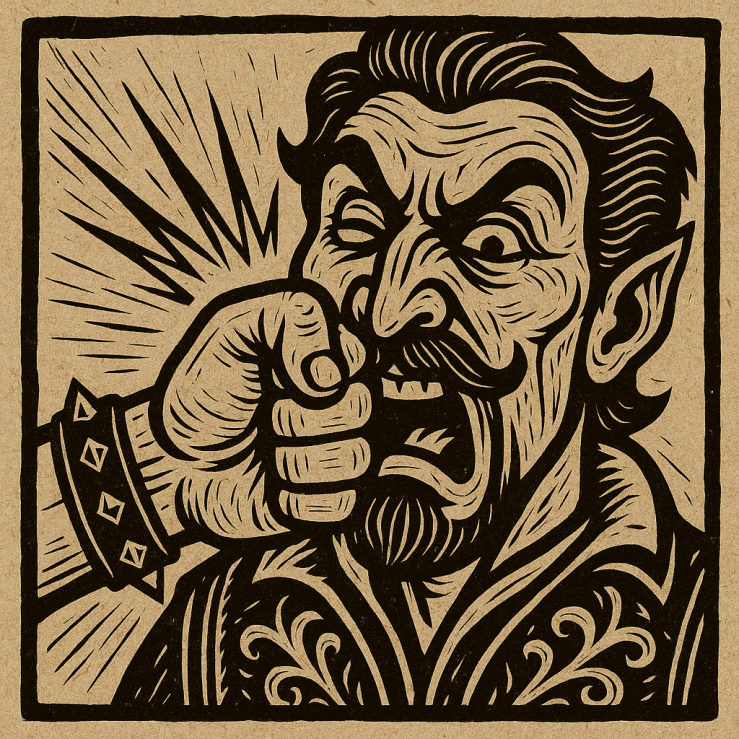
Then spun and punched Thornstar square in the jaw.
The sound was magnificent. The kind of crack that ends duels and careers. The crowd erupted.
Thornstar crumpled like overpriced parchment. His men—Az included—blinked in stunned silence.
Trunch stepped forward—not toward the fight, but toward the man still gripping Avelyn Goldwillow’s arm.
His voice was calm. Deadly calm.
“Unhand her.”
The man blinked.
“I said,” Trunch repeated, louder now, “unhand her. Is that how you treat a lady in front of a crowd? Like some snatched scroll, dragged into daylight and forced to perform?”
The man looked around for support. Found none. The crowd’s jeering had shifted now—eyes turning, murmurs stirring.
Trunch took one more step. “She is a clerk. A citizen. And if you’re going to play at law and tradition, then start by showing the proper respect. Or I swear, by all that’s sacred and mildly inconvenient, you’ll be the next one on your knees.”
The man let go.
Avelyn staggered back. Trunch caught her arm, not to restrain, but to steady. She didn’t speak. Just gave him a look. One that said thank you without needing words.
Trunch nodded once, smiled, and unleashed a burst of arcane engery that hit the man square in the chest.
“Don’t just stand there, you idiots!” Thornstar wheezed from the floor. “Do what I’ve paid you to do!”
Az didn’t move.
He looked at Thornstar, then at Day and Umberto, both standing firm, unflinching. Then out at the crowd, who were no longer just an audience, they were watching him. And not with fear.
With expectation.
It hit me all at once.
Az didn’t want to be here.
Not like this.
He’d been hired to be muscle, sure. But this? This wasn’t muscle, it was manipulation. Thornstar didn’t command loyalty. He rented obedience.
“Now, you gigantic oaf!” Thornstar screeched, flailing from the dirt and kicking Az squarely in the ankle.
Az flinched, but not from pain. From shame.
He growled. Not at Umberto.
At everything.
Then finally, reluctantly, stepped forward.
But Day moved at the same time. Smooth. Silent. Eyes narrowed.
Their clash began with a blur of fists and elbows. More test than fury, as the rest of the group surged forward.
Din called out to the official’s table – loud, clear, resolute:
“I guess you can put us down as a team.”
And that was it.
The crowd didn’t cheer, they roared. The officials scrambled. Thornstar groaned. Tufulla, halfway through a bite of celebratory tart, looked like he’d just swallowed it the wrong way.
And me?
I finally flipped to a fresh page in my journal.
Because whatever this was becoming…
…it was worth chronicling.
 The Chronicles of Klept