Chronicles of Klept: Chapter III
The aftermath of a festival-wide attack is, at best, a logistical nightmare and, at worst, a perfect excuse to reevaluate one’s career choices. In the grand chaos of fire suppression, triage, and general screaming, the newcomers did not flee, which was either an act of bravery or an indication of very poor decision-making skills. Possibly both.
As smoke curled through the air and the wounded were tended to, the group did what any sensible, suspiciously competent individuals would do: they stuck around, helped where they could, and occasionally got in the way. The surviving attackers—those who were both lucky and unfortunate enough to have avoided being skewered, incinerated, or otherwise forcefully discouraged—were rounded up by the local guards. Interrogations began immediately, as did the standard bureaucratic nightmare of filing reports on why exactly the festival had suddenly become a battlefield.
It was about an hour later when Guard Captain Rynn approached the group with an offer that was, depending on one’s perspective, either a polite invitation or a veiled threat.
“You can come with us to Dawnsheart and give your statements. Or we can take you into custody, and you can explain yourselves from behind bars.”
The group took a moment to process this, and the air between them grew tense. There was a moment—just a flicker—where it seemed as though certain members were considering an alternative response, something involving violence or a sudden commitment to sprinting in the opposite direction. But, after a weighted pause, a decision was made. They would go. Of their own volition. Mostly.
Captain Rynn, never one to turn down an opportunity for efficiency, offered them transport—a ride in the back of a cart, under watch and protection. “After all,” he said, “there may still be more attackers.” Which, while technically true, was also a convenient way of ensuring they wouldn’t attempt to simply wander off.
While Tufulla and the other Readers rode ahead with their own escort, I made what some might call a reckless decision and what I call a perfectly justifiable act of journalistic integrity—I chose to travel with the newcomers. For posterity, of course. And because, quite frankly, they were already the most interesting thing to happen to Dawnsheart in years.
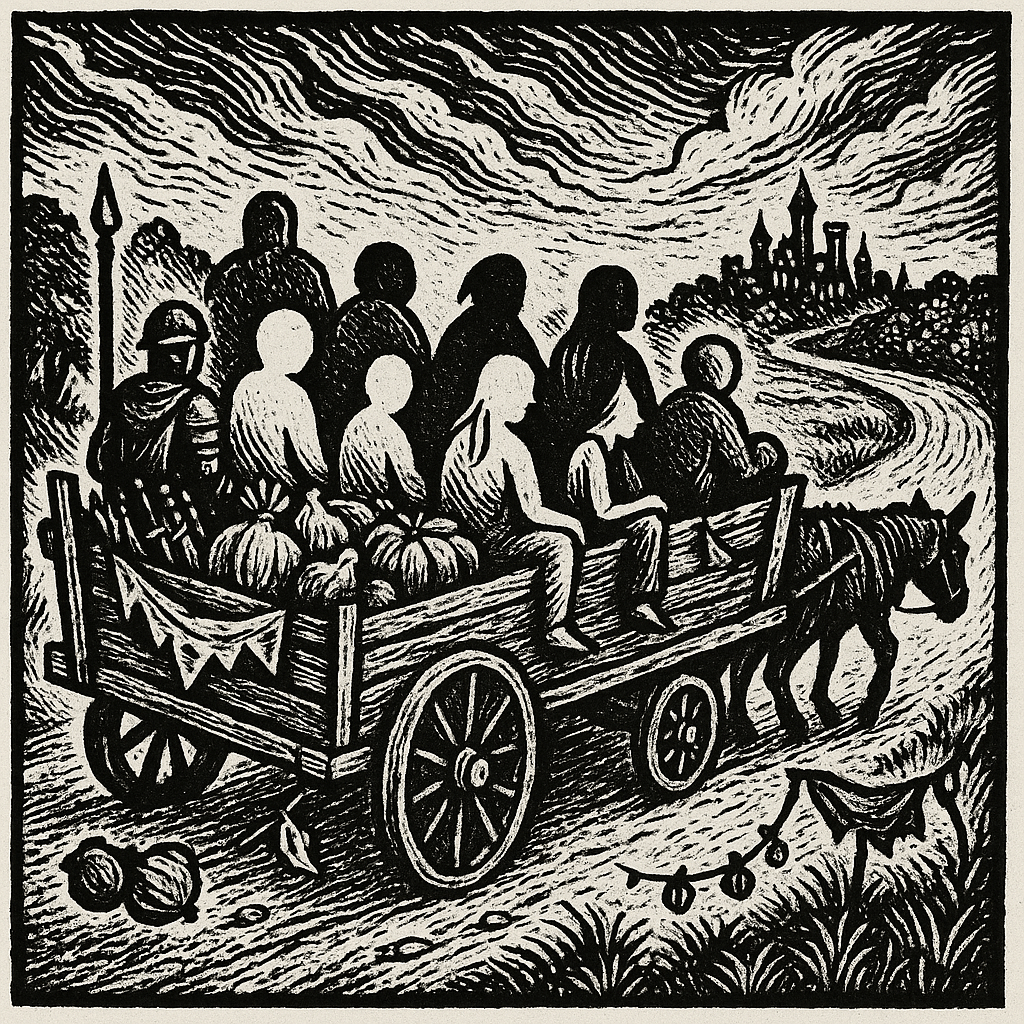
Two gnomes. One elf. A halfling. A dwarf. And one… individual whose race, origin, and general vibe defied easy classification. Add four Dawnsheart guards, and myself—a church chronicler with more questions than answers—perched at the front of a cart that smelled vaguely of parsnips and burnt incense. All sitting together on a slow, rattling, lurching cart pulled by a pair of mules that looked older than prophecy itself, trundling over stones and potholes on the road. We were heading for Dawnsheart and vacating the Kashten Dell like the closing act of a poorly-rehearsed tragedy—leaving behind the Prophet’s Rock, a broken stage, several unanswered questions, and the smoldering remains of what had begun as a lovely and very quaint rural festival.
The cart was not built for comfort. Or dignity. Or anything, really, beyond the transportation of onions and regrets. Between us all, bags of vegetables rolled gently with the motion. A banner from the festival still fluttered limply off the side. A broken string of lanterns rattled against the boards. The smell was equal parts turnip, sweat, and uncertainty.
The planks creaked with every bump, and the mules pulling it gave the distinct impression as though forward motion was more of a suggestion than a commitment.The group’s weapons had been taken—or more accurately, surrendered—stacked in a careful heap behind the front-most guard. Just close enough to tempt the reckless. Just far enough to make trying a very bad idea.
Silent and armed, the guards watched the group with the kind of expression that said please try something, so we can have something to write in our report. I sat near the front of the cart, my church robes affording me a moderate level of respect—or at least deference—from the guards. For the most part, I was left alone, which suited me fine.
It gave me time to study the odd collection of individuals seated around me.
At first, no one spoke. Just the rhythmic creak of the cart, the occasional sigh from a mule, and the distant rattle of someone’s pilfered cutlery.
But the silence wasn’t tense—it was unfamiliar. And that’s when it hit me. A realization so fundamentally baffling I had to double-check my memory, just to be sure I hadn’t missed something obvious.
They didn’t even know each other.
Not truly. Not before all this.
And yet, somehow, they’d fought like a unit. Or at least a very determined accident.
The only two members who seemed to have an established history were a dwarf, stoic and silent, and the perpetually enraged gnome with an axe large enough to be classified as a siege weapon. The others? Mere acquaintances. Or, in some cases, complete strangers who had simply found themselves inexplicably thrown together.
It was an unsettling revelation. Not because they were unfamiliar with one another, but because of how well they had worked together protecting us at the festival. Their movements in battle, their coordination—it had given the impression of seasoned allies, comrades bound by years of shared struggle. And yet, here they sat, some idly inspecting their fingernails, others muttering to themselves, giving off the distinct energy of people who were still deciding whether or not they liked each other.
For the first time since the attack, I felt something beyond fear and exhaustion. I felt curious. A terrible sign. That’s usually how trouble introduces itself: not with a bang, but with an interesting question and no good reason to leave it alone.
Because if these were strangers, if these were outsiders with no prior allegiance to one another, then what in all the heavens had compelled them to fight side by side? What had drawn them here?
You see, fate has a curious way of nudging together the sorts of people you might not trust with a spoon, let alone the fate of the continent. And yet, here in front of me on a bumpy cart ride are a group of possible heroes, or at least, people with a worrying tendency to survive things they absolutely shouldn’t.
Now, I feel it is my solemn duty at this point to introduce you to the merry assemblage of chaos with whom I suddenly found myself entangled. For your benefit—and indeed for your personal safety—I’ve taken it upon myself to describe each member of our little troupe in turn. I do this because should you encounter any of these individuals in the wild, it’s best you know to turn around, walk briskly away, and perhaps consider relocating your entire village.
The first thing one notices about the Dwarf, Din—aside from the sheer density of his existence—is his beard, which appears to have suffered more fire damage than most battlefields. It is white as old parchment, wiry as an overused broom, and woven through with enough flint and stones that I half expect him to burst into flames should he trip too hard.
The second thing one notices—or at least what I noticed, because clearly, no one else in this group has a proper appreciation for history—is the symbol of the Sparkwhiskers clan.
This is significant because the Sparkwhiskers are supposed to be dead.
Oh, not in the casual, ‘faded into history, lost to time’ sort of way. No, the Sparkwhiskers were wiped out, their halls ransacked and abandoned after a brutal raid generations ago. Scholars (such as myself) have long debated whether any survived, but if they did, they certainly wouldn’t be out in the open. The few rumors of their existence speak of exiles, wanderers, smiths in hiding—never proudly displaying their crest in broad daylight like an anvil begging for a hammer.
Which leaves only two possibilities:
- This Dwarf is a fraud. Some fool playing at lost heritage, slapping a forgotten symbol onto his armor for the sake of mystery and misplaced reverence.
- He is exactly what he appears to be. A Sparkwhisker who has somehow survived and, for reasons beyond my understanding, has chosen to live in plain sight.
If it is the latter, then he is either the bravest dwarf I have ever met, or the most reckless. Possibly both. There is also the distinct chance he simply does not care.
Everything about him suggests a man who has walked through fire and decided he might as well keep going. His armor, a masterwork of dark steel and brass inlay, is marked with the symbol of his lost clan—not hidden, not subtle, but boldly engraved as if daring fate to strike him down for it. His warhammer, a thing of terrible beauty, is shaped like an anvil, the words Fear No Anvil etched in Dwarvish script across its side. A personal motto? A battle cry? A challenge?
Most curious of all, he does not seem lost. Many wanderers carry a weight of aimlessness about them, but Din sits like a mountain that has decided to travel. There is purpose in his presence, though whether it is divine guidance or pure stubborn will, I do not yet know.
He watches the others in the cart with quiet patience, as if assessing them the way one might examine raw ore—judging what can be reforged and what is best left discarded.
I will have to watch him closely.
If he is a Sparkwhisker, then he carries more than just the burden of survival—he carries a history that was supposed to have ended.
And history, as I am painfully aware, has a way of catching up to those who think they have outrun it.
There is something distinctly unsettling about the Halfling, Wikis.
Not in the conventional sense of menace—she does not loom, nor glower, nor carry an aura of immediate doom. Rather, she exudes the sort of deep, twitchy paranoia one expects from someone who has just stolen something and believes, perhaps correctly, that the entire world is now after them.
She sits in the cart coiled like a spring, her fingers flicking toward a particularly ornate ring on her hand every few minutes, as if reassuring herself that it still exists. Her wide, gleaming eyes flick from person to person, her posture halfway between flight and attack, though which she is more prepared to execute remains unclear.
Her hair, a tangled, leaf-laden masterpiece of wild neglect, appears to have once known the concept of grooming but long ago rejected it as an outdated societal construct. Somewhere within the knots and vines, a pony-tail relic of a forgotten civilization clings to existence, a brittle vine attempting to hold back what is clearly the untamed wilderness incarnate.
Her cloak, a suspiciously well-worn garment of uncertain origin, is wrapped around her with the sort of deliberate care one might expect from a dragon coiled around its hoard. This, combined with her lack of any apparent clothing beneath it, suggests either a deeply committed tactical decision or a complete disregard for social convention. Given that she does not appear particularly embarrassed, I suspect it is the latter.
She trusts no one. I can tell because she has not blinked in the last three minutes, which is either an incredibly effective intimidation tactic or a sign of an undisclosed medical condition. Her eyes flit between us, sharp and calculating, as though she expects someone, at any moment, to attempt to rob her of whatever mysterious valuables she has tucked away beneath that cloak. (For the record, I have no interest in finding out.)
Her possessions are weathered but well-kept—a longbow slung across her shoulder, a shortsword at her hip, each item looking as though they’ve seen more use than most noble-born knights will in their lifetimes. The way her fingers hover near the hilt of her sword suggests that she has absolutely thought about using it on everyone here at least once.
Her feet, wide and tough, are clearly strangers to shoes, and from what I can see, strangers to the concept of washing as well. This is less surprising than it should be. Given her overall aura of ‘woodland cryptid attempting to integrate into society’, I would be more shocked if she suddenly produced a well-polished pair of boots.
Whatever her story is, it is clear she is not accustomed to company, nor does she desire it. She watches us all with the barely restrained suspicion of a raccoon guarding a cache of stolen silverware, and I am quite certain that if anyone in this cart so much as looks at her oddly, they will find themselves either shot, stabbed, or violently distracted by an unexpectedly deployed cloak.
I have no idea what has led her here, nor why she has agreed to travel alongside these strangers, but I suspect she is either running from something—or toward something.
It has been said that rage burns brightest in the smallest of vessels. The angry Gnome himself never so much introduced his name as barked it—Umberto—like it was both a warning and a challenge.
He is a smoldering ember of barely-contained fury with an overwhelming compulsion to punch anyone who so much as glances at him incorrectly.
His axe is enormous. His sideburns are enormous. His anger is, somehow, even more enormous. His clothing, however, is decidedly minimal. He wears a loincloth, a permanent scowl, and a leather shoulder harness strapped tight across his chest. No ornamentation. No nonsense. If I had to describe him to someone who had never had the privilege of meeting him (or being threatened by him), I would say that he looks like an enraged gladiator who misplaced his armor but decided to fight anyway.
His mohawk defies gravity with the same force he defies social conventions. His mustache is meticulously groomed, in direct contrast to his entirely unrestrained attitude toward everything else in life.
He sits on the cart tense, coiled like a bomb with no discernible timer—and he holds a book.
Reverently. Almost respectfully.
But with the unmistakable posture of a man who might still use it to bludgeon someone if the mood shifts.
There is no relaxation in him—only a simmering, ever-present aggression. I get the feeling he’d punch an old woman without hesitation if he didn’t like what she said.
At first glance I would never have guessed it, but Umberto Halfordian is literate. Worse, he is well-read. And, as I have just discovered, passionately opinionated about it.
At this very moment, the book he is clutching a well-worn copy of ‘Sheri Honkers and the Gelatinous Boob’, the infamously rare, first novel by the self proclaimed Scribe of Scandal, Barbara DongSwallower, and he’s threatening to use it as a weapon in what has rapidly escalated into a full-blown literary brawl with one of the guards.
The guard in question, a poor, unfortunate soul with absolutely no idea what he has just stepped into, made the dire mistake of offhandedly referring to DongSwallower’s prose as ‘drivel.’
This was, evidently, a crime of the highest order.
Within seconds, Umberto had launched into a verbal assault that I am quite certain has caused the guard to question every decision he has ever made.
Within minutes, the debate had evolved into a shouting match that required two additional guards to separate them.
Din, for his part, is laughing so hard he is struggling to hold Umberto back. This suggests that this is not the first time this has happened.
At this point, I am half-expecting Umberto to formally challenge the guard to a duel for slander.
If he does, I hope he waits until after we arrive in Dawnsheart.
The road is bumpy, and it is already difficult enough to write without having to dodge a flying gnome mid-swing.
There are few things more disconcerting than sharing a cart with someone who, immediately after a bloody battle, cheerfully pulls a pie from a fold in their robes and begins eating it—unless that someone may or may not have a face.
I say may not because I have, as of yet, not actually seen the one called Yak’s face.
The hood stays up. The shadows cling unnaturally. When he moves, it is soundless, deliberate, controlled. It is the movement of someone who has either spent a lifetime ensuring he is unnoticed or is, in fact, a specter of my imagination.
It is difficult to get a read on someone who deliberately has no readable features.
His robes are long, nondescript, the kind of perfectly unmemorable clothing that blends into a crowd for minutes before one realizes something is… off. The effect is subtle but chilling. It is the kind of disguise that only becomes apparent once the wearer is already gone.
And then, there is the way he moves in shadow.
I witnessed it during the attack on the Harvest Festival.
In the chaos, where most sought steel or sorcery, Yak became something else entirely. While others fought with brute strength or desperate defense, he simply… vanished. No arcane gesture, no incantation. Just the quiet, effortless slipping from presence to absence.
It was Yak who I mistook as one of the attackers turning on their own. He became the enemy. Took their faces, their forms, walked among them as if he had always belonged. And when they turned to him for orders, for leadership—he cut their throats.
He moves like a shadow with purpose, like silence given form. He waits—poised, unseen—and when the moment is right, he is simply there.
No struggle. No sound. No warning.
Just the sudden, bone-deep realization that something is behind you.
And yet.
This same figure currently sits swinging his legs off the back of the cart, joyfully eating a pie of dubious origin like a mischievous child, and giggling every time the cart creaks in a way that sounds vaguely like flatulence.
It’s deeply unsettling.
Not because of the contrast, but because he seems perfectly at home in both extremes.
There is something untethered about him—a man who has borrowed so many identities that he has perhaps misplaced his own. If he had a past, it is hidden, buried beneath layers of deception and careful non-existence. But I suspect it was not a kind one.
There is a particular kind of person who radiates competence so profoundly that it forces others into an immediate and deeply personal reflection on their own inadequacies.
Day is that person. He is also the very same Elf I saw earlier this morning discard a comically large bean into a sacred pond.
At this very moment, as the cart jostles and rattles its way toward Dawnsheart, he is studying his spellbook.
Not idly flipping through pages. Not absentmindedly reading. Studying.
With the kind of focus that suggests he already knows what he’ll need three moves from now, and is simply double-checking the math to be polite.
His posture is immaculate. His movements precise. He turns each page like it contains the answer to a question you haven’t asked yet, but that he has.
He looks like someone constantly running calculations.
Not idle thoughts. Contingencies. The fastest route to every weakness in the room. The cleanest, most efficient way to do maximum damage in the shortest time possible.
And that is, frankly, terrifying. Because I watched him wield a blade with a ballerina’s grace and a lumberjack’s accuracy.
Elegance and carnage in equal measure.
And yet, despite this, he is keenly aware of everything around him.
I know this because at one point, Umberto shifted too suddenly, nearly tipping over a crate of supplies, and Day’s hand shot out—not to stop him, but to catch the crate before it could even begin to tumble. His eyes did not even open. He simply… knew.
I am not convinced he isn’t seeing everything before it even happens.
Alos, I need to talk about his braid.
It is perfect. Not just tidy—not just well-maintained—but actively defying the natural laws of travel, battle, and common physics.
We just survived an attack, a fire, and a battlefield-turned-festival. We have ridden in a cart for miles on uneven roads, through wind and dust. And yet, his braid remains immaculate.
I am fairly certain he has not touched it once.
It has, in a very real sense, become a symbol of my own disorganization.
The other gnome in this group, Trunch appears, in many ways, to be the most reasonable and level-headed member of this group. Which means in all likelihood, there is something deeply, catastrophically wrong with him.
There is an undeniable dignity to him, which is remarkable, considering that the first time I saw him, he was frantically attempting to pilot a four-foot-long bean across a sacred lake.
This is what is most unnerving about him—not the eldritch energy at his fingertips, not the uncanny wisdom behind his eyes, not even the fact that he is a warlock and we have all just decided to be okay with that.
No. What unsettles me is his complete, unwavering reasonableness. For him, piloting a floating bean across a lake to reach a rock and satisfy his own personal curiosity was perfectly reasonable.
Trunch is resolute. Thoughtful. He seeks diplomacy first, violence second. And yet, when diplomacy fails, he will, without hesitation, hurl a crackling beam of eldritch destruction at his enemies. All with an unnerving amount of calm.
I saw it myself, from atop the Prophet Rock.
One moment, he was stranded on the sacred stone, looking very small and very wet. The next, his hands were ablaze with dark power, sending bolts of otherworldly force across the battlefield with the efficiency of a man who had long accepted that sometimes, words fail.
Anyone familiar with warlocks knows the signs.
- The eldritch blasts.
- The occasional crackling fingers, as if they can’t quite turn the magic off.
- That distinct look in their eye that suggests, at any given moment, they might be listening to something you can’t hear.
Trunch has all of these and more but it would be irresponsible not to mention the topknot.
While most bald men make peace with their fate, Trunch has rejected the notion entirely. Instead, he has cultivated a single, defiant sprout of hair, bound into a sturdy topknot atop his head, like a banner proclaiming both wisdom and quiet rebellion.
His mustache, eerily similar to Umberto’s, is where their similarities end.
Because where Umberto’s expression is one of permanent fury, Trunch’s is… different.
He has the look of a man who wants to know everything—who looks at the world as a puzzle to be solved, a book to be read, a mystery to be unraveled. But there is also something else—something darker.
A warlock’s magic is not given freely. It is not earned through training or study or divine favor. It is not a natural gift bestowed at birth. It is bargained for. Paid for.
I do not know what Trunch paid.
I do not know who—or what—is watching him.
And, for the sake of my own sanity, I will not ask.
And so we rattled on—six strangers, four guards, and one very tired chronicler, all bouncing along in a cart that smelled like onions and old decisions.
We were nearing Dawnsheart.
But something told me the real journey was about to begin.
Unfortunately.
 The Chronicles of Klept